What 80/20 means
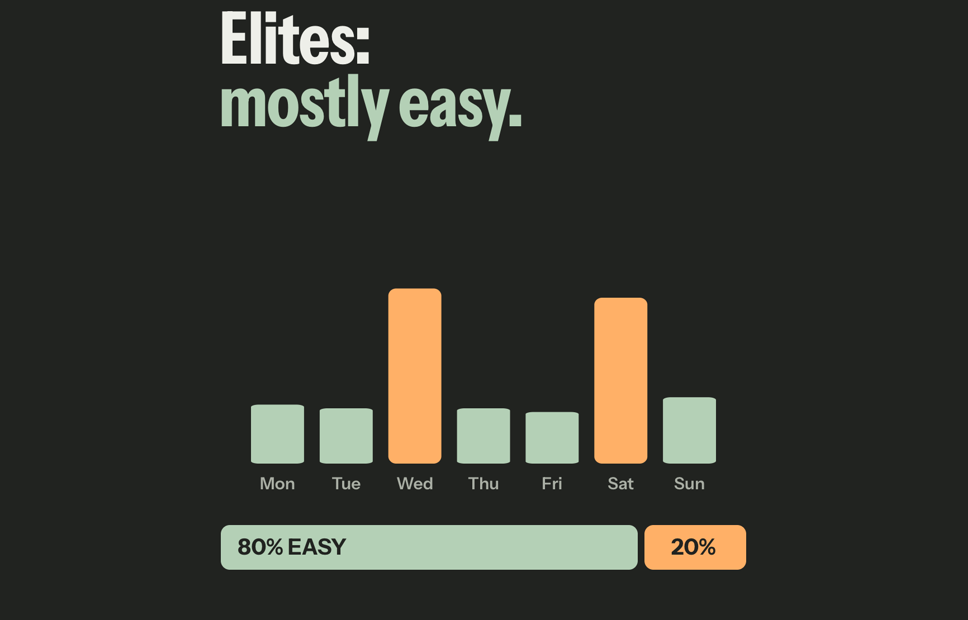
Reviews of elite endurance athletes find that about 80% of their sessions are at low intensity and about 20% are hard. Very little sits in the middle.
Many recreational runners do the opposite: almost every run at the same medium effort. It feels productive, but it is too hard to recover from and too easy to make you faster. 80/20 describes elites; it is a guide for the rest of us, not a fixed recipe.
What the study found
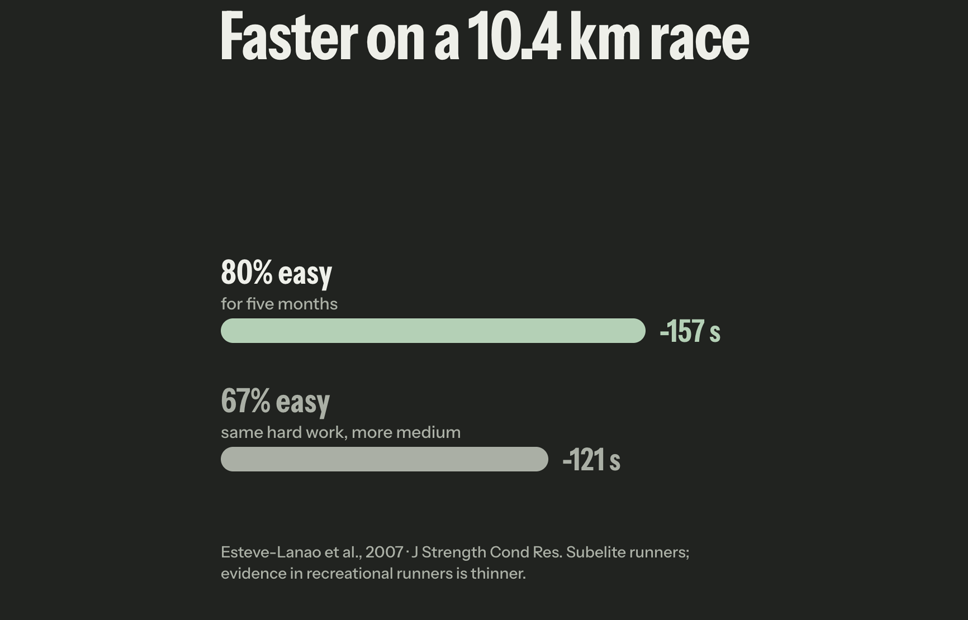
Esteve-Lanao et al. (2007) split 12 subelite runners into two groups for about five months. Both did roughly the same amount of hard work. One spent about 80% of its time easy; the other about 67%, with more time at medium effort.
Both groups got faster on a 10.4 km cross-country race. The mostly-easy group improved more. With 12 runners, this is supporting evidence, not proof. In recreational runners the evidence is thinner: a 10-week study by Muñoz et al. (2014) pointed the same way, but the difference was not statistically significant.
| Group | Time easy | Improvement |
|---|---|---|
| Mostly easy | about 80% | 157 s faster |
| More medium effort | about 67% | 121 s faster |
Three checks that a run is easy
Use them together. Any one of them can mislead you on a hot day or after a bad night.
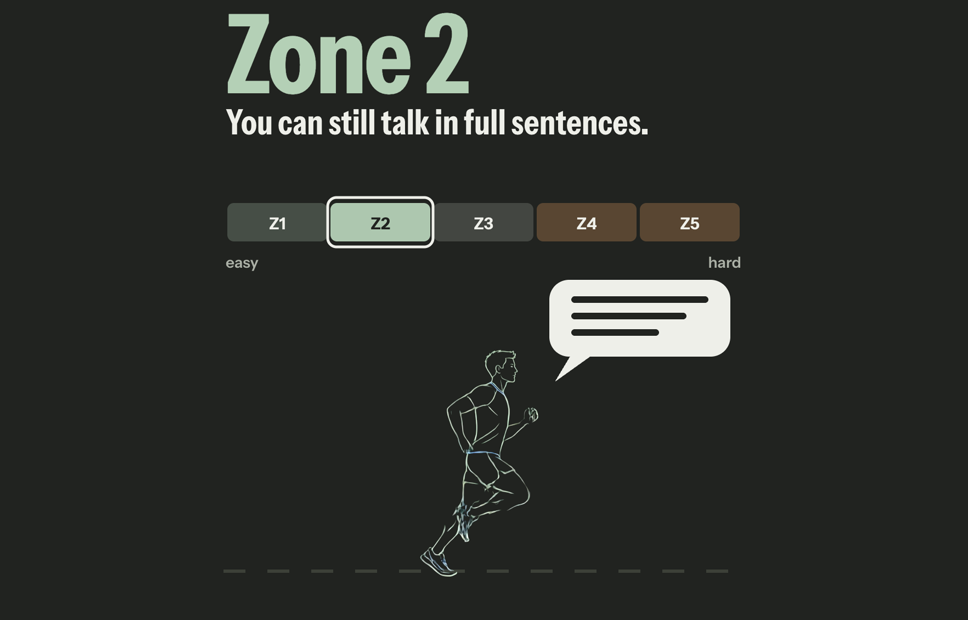
- You can talk in full sentences without gasping.
- Your watch shows roughly zone 2.
- It feels like 3 out of 10.
Grade your last 8 weeks
Paste this into Claude or ChatGPT with telo connected. It reads your runs by week, adds up the time in each heart-rate zone and shows how much was easy, moderate and hard, compared with 80% easy.
It only reads data. It uses complete weeks so a half week does not skew the share, and it lists the five runs with the most zone 3 time, which are usually the easy days that drifted.
Using telo, take my runs from the last 8 complete Monday to Sunday weeks (skip this week). Use weekly running sessions to sum time in each heart-rate zone. Show week by week and in total the share of zone-covered time that was easy (zones 0-2), moderate (zone 3) and hard (zones 4-5), and how far easy is from 80%. List the 5 runs with the most zone-3 minutes. Count runs with missing zone time. Say which max HR the zones are based on, and tell me if my easy runs may look harder only because of it. Don't estimate anything telo doesn't return.What the test showed
In our read-only test on one account, the prompt ran with one weekly call plus one detail call per listed run. The result came out mostly moderate, with only about a tenth of the time easy.
Part of that was the zone model, not the training. telo builds zones from the highest heart rate seen in your workouts. If that peak is below your true maximum, every zone shifts down, and runs that felt easy land in zone 3. That is why the prompt asks which maximum was used and whether it may make easy runs look harder. If you know your maximum heart rate, tell the assistant and judge the result with it.
Where the data stops
Zones need heart rate during the run. Runs recorded without it, or with gaps, are counted as missing, not as easy. A wrist sensor can lag at the start of a run and spike on cold days.
This is not medical advice and not a training plan. telo shows what your watch recorded; it does not decide how hard you should train.
Practical questions
Does 80/20 apply to recreational runners?
It is a guide, not a rule. The study in the Reel had 12 subelite runners, and in a study of recreational runners the difference was not statistically significant. Running most of your time easy is still a sensible starting point.
Why do my easy runs show up in zone 3?
telo builds zones from the highest heart rate seen in your workouts. If that peak is below your true maximum, the zones shift down and easy runs land in zone 3. Tell the assistant your maximum heart rate and cross-check with the talk test.
Does the prompt change anything in my account?
No. It only reads runs and zones through telo and builds the answer in the conversation. Runs without heart rate count as missing, not as easy.
Sources and availability
Plans, regions and interfaces can change. Check the official sources before setting up.
- Esteve-Lanao et al., 2007 · J Strength Cond Res 21:943-949
- Muñoz et al., 2014 · Int J Sports Physiol Perform
- Seiler and Tønnessen, 2009 · Sportscience
- telo · Reel ep06 · 2026-11-08
How this guide was prepared
The prompt was tested by a subagent on 7 November 2026 using only telo read tools, against one account. The wording was adjusted after the test: complete weeks only, zone 0 counted as easy, shares computed over time with zone data, the top 5 runs, and a count of runs without zones. Frames come from Reel ep06. Prepared with AI assistance.