What 12-3-30 is
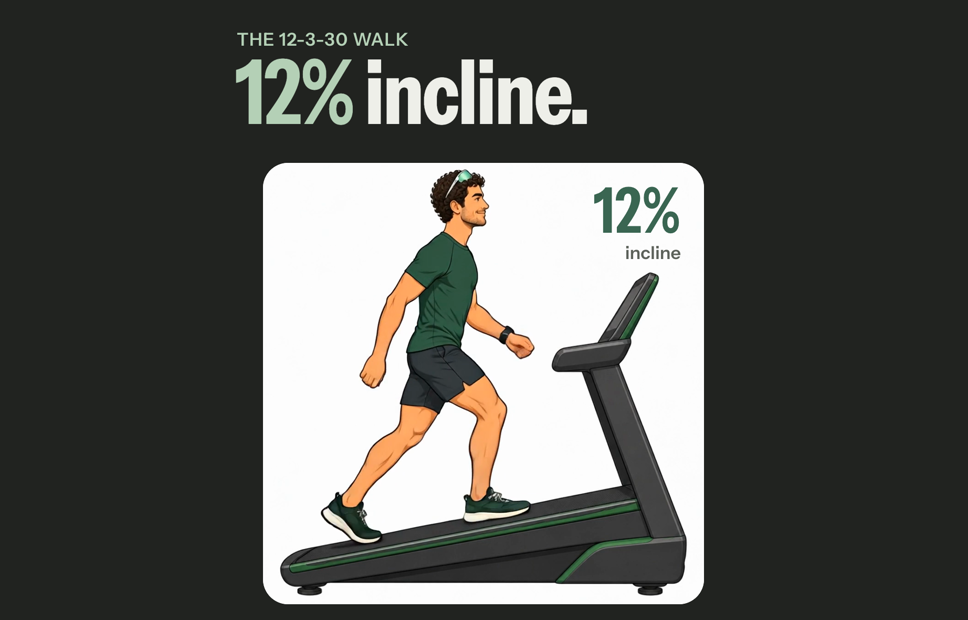
Set a treadmill to a 12% incline and 3 miles an hour (about 5 km/h), and walk for 30 minutes. That's it. It spread on social media because it feels like a walk, not a workout, and still leaves you sweating.
Don't hold the rails. Leaning on them takes weight off your legs and lowers the effort; let your arms swing instead.
How it compares with running
By the American College of Sports Medicine walking equation, 3 mph at a 12% grade costs about 8.3 METs, roughly the same as an easy jog at about 8 km/h. You get a jog's effort without the impact of running.
To be fair, running burns calories faster per minute, and a small lab study comparing the two found the same. The 12-3-30 walk wins on something else: it's the workout many people will actually repeat, especially if they don't enjoy running or are coming back from a break.
The trap: 30 minutes on day one
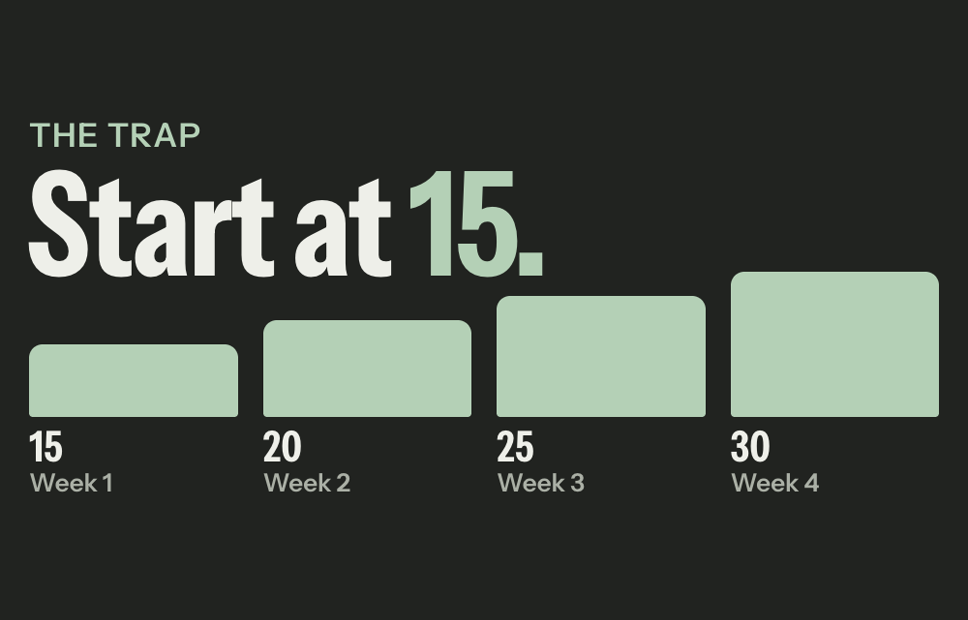
Most people try the full 30 minutes the first time. Calves and shins burn, the next day hurts, and they never come back. The third number is a goal, not a starting point.
- Week 1: 15 minutes, three times.
- Week 2: 20 minutes.
- Week 3: 25 minutes.
- Week 4: 30 minutes.
- If you walk less than about 5,000 steps a day, start at 10 minutes.
Build the plan and send it to your Apple Watch
Paste this into Claude or ChatGPT with telo connected. It reads your last 28 days of steps to pick a starting point, lays out the four weeks, and asks when you want to walk this week.
Then it creates each walk with telo's create_workout_plan: a flat warm-up, the incline walk and a cool-down, ready on your Apple Watch. The Watch can't change the treadmill's incline, so the step name tells you what to set. The first time, open telo on iPhone, go to Planned workouts and tap Schedule on Watch.
Using telo: 1) call query_daily for steps, granularity day, last 28 days, and give my average daily steps (only days with data). 2) Build a 4-week 12-3-30 plan (12% incline, 3 mph, 3 walks a week): week 1 at 15 minutes, +5 a week up to 30. If I average under 5,000 steps, start at 10. 3) Ask which days and times this week, then call create_workout_plan once per walk: walking, indoor, 3 min flat warm-up, the main walk named "12% incline · 3 mph · no rails" (the Watch can't set the incline), 3 min cool-down. Tell me to open telo on iPhone > Planned workouts > Schedule on Watch the first time.What the test showed
On one account, the step average was well above 5,000, so the plan started at 15 minutes. telo accepted the walk as a pending plan, and we cancelled it right after.
The first version of the prompt asked for weekly steps. telo returns the sum for each week, and the first and last weeks were partial (one day and six days), so dividing by 7 gave a wrong average. Asking for days fixed it.
Where the data stops
Steps come from iPhone and Apple Watch, merged by Apple Health. They say how active you are, not how fit, and they don't see a treadmill's incline.
This is not medical advice. If you have heart, joint or balance problems, check with a professional first, and stop if you feel chest pain, dizziness or sharp joint pain.
Practical questions
Does 12-3-30 burn more than running?
Not per minute: running burns calories faster. At a 12% incline and 3 mph the effort is close to an easy jog, without the impact, and it's a workout many people can repeat every week.
Why not start with the full 30 minutes?
Because that's where most people quit: calves and shins aren't used to the incline. Start at 15 minutes and add 5 a week, or at 10 if you walk under 5,000 steps a day.
Does the prompt create anything in my account?
Yes, only after you confirm the days: it creates this week's walks as planned workouts in telo. The first time you open telo on iPhone and tap Schedule on Watch, and you can cancel any of them later.
Sources and availability
Plans, regions and interfaces can change. Check the official sources before setting up.
- ACSM's Guidelines for Exercise Testing and Prescription · metabolic equations
- Coverage of the UNLV 12-3-30 vs running study
How this guide was prepared
The prompt was tested on 8 November 2026 against one account, with the owner's permission. It read 28 days of steps and created one walk with create_workout_plan, which was cancelled right after. The first version asked for weekly steps; telo returns weekly sums and partial edge weeks, so an assistant dividing by 7 got the average wrong, and the prompt now asks for days. The energy comparison uses the ACSM metabolic equations. Frames come from Reel ep14. Prepared with AI assistance.