What the study found
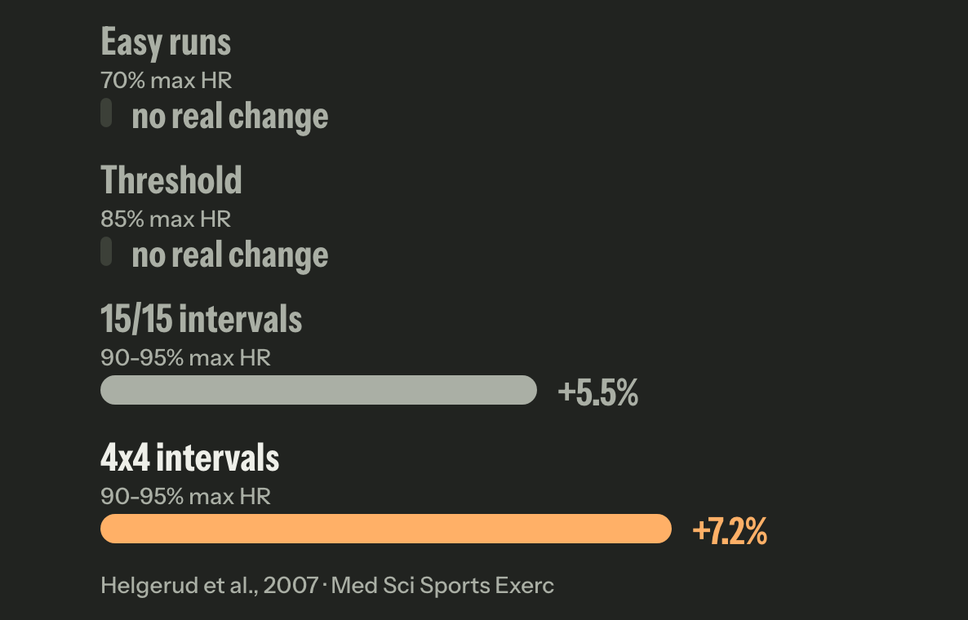
Helgerud et al. (2007) compared four running protocols in 40 moderately trained men over eight weeks. The interval groups increased VO2 max; easy running and threshold running showed no significant change in that measure.
This was a small, male-only sample. It does not show that easy running is useless or guarantee a 7.2% gain for you. The study used three sessions a week, not the twice-weekly schedule in the Reel.
| Group | Intensity (% maximum heart rate) | VO2 max change |
|---|---|---|
| Easy running | 70% | No significant change |
| Threshold | 85% | No significant change |
| 15 s hard / 15 s active recovery | 90–95% / 70% | +5.5% |
| 4 × 4 min / 3 min active recovery | 90–95% / 70% | +7.2% |
The session from the Reel
The Reel suggests twice a week. This is its practical version, not a replication of the study frequency or a personalised prescription. With recovery after all four efforts, the plan below totals 43 minutes.
- Warm up easily for 10 minutes.
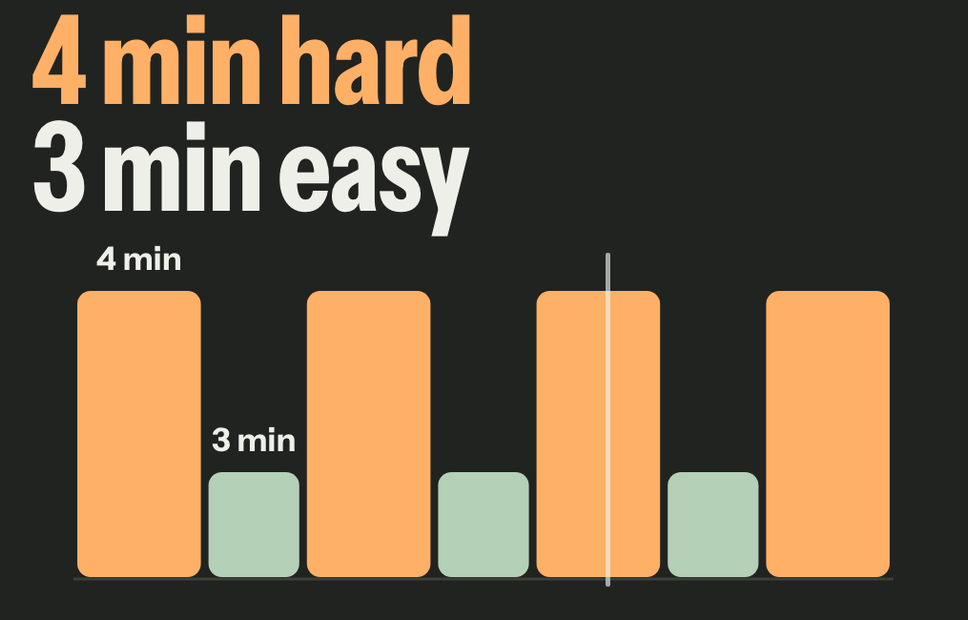
- Run 4 minutes at 90–95% of maximum heart rate.
- Jog easily for 3 minutes at about 70%.
- Repeat the effort and recovery block four times in total.
- Cool down for 5 minutes.
How hard is hard?
The target is a percentage of maximum heart rate, not maximum speed. For a supplied maximum of 190 bpm, 90–95% is about 171–181 bpm and 70% is 133 bpm. This is arithmetic, not a recommended maximum for you.
telo zones use the highest heart rate observed in workouts unless you supply your own maximum. An observed peak can underestimate your physiological maximum, or be distorted by a sensor spike. That makes a narrow 90–95% target uncertain. If you know your own maximum, tell the assistant to use it instead and name its source. Do not treat an isolated spike as a tested maximum.
Put the 4x4 on Apple Watch
Paste the DM prompt into Claude or ChatGPT with telo connected. It reads your running history and creates one structured plan in your account. Replace “this Tuesday” with a future date and time within the next seven days, including your time zone. If you know your maximum heart rate, replace the observed-maximum instruction with that value.
Review the maximum and every target before scheduling. The prompt is contract-checked, not execution-tested. Creating a pending plan does not confirm delivery to Apple Watch.
- Open telo on your iPhone and go to Planned workouts.
- Review the warm-up, four repeats, heart-rate ranges and cool-down.
- Tap Schedule on Watch and grant permission on the first delivery.
- On Apple Watch, open the Workout app, find the planned run and start it. “Scheduled” means the iPhone accepted scheduling, not that the Watch confirmed receipt.
Using telo, find the highest heart rate I've reached in my runs over the last 6 months and treat it as my max HR. Then create a 4x4 interval run on my Apple Watch for this Tuesday: 10 min easy warm-up, then 4 repeats of 4 min at 90-95% of that max HR and 3 min easy jog at about 70%, then 5 min cool-down. Put the heart-rate ranges on each step. Tell me the numbers you used and how to start it on the watch.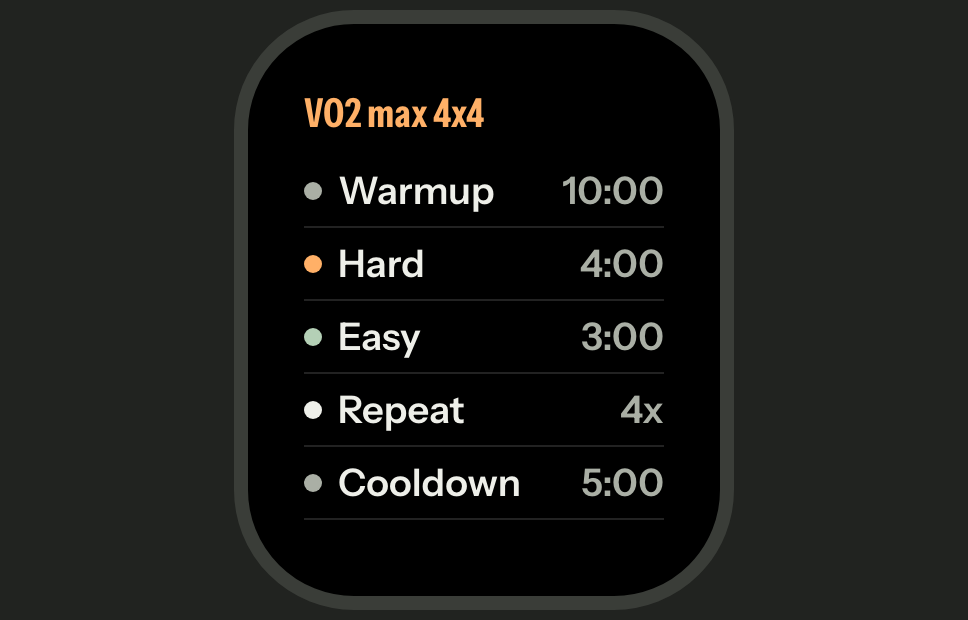
Follow your VO2 max afterwards
This second prompt only reads data and draws the chart in your conversation. Apple Watch estimates VO2 max during outdoor walks, runs and hikes. Judge its trend over weeks, not days; an individual estimate can still change after a workout.
Weekly means give each stored daily value equal weight. Counts are days with data, not raw sensor readings. A missing week is a gap, not a zero or evidence of lost fitness.
Using telo's read-only tools, check data availability, then chart my VO2 max in this chat week by week for the last 16 complete Monday-to-Sunday weeks, excluding the current week. Show each week's date range, the average of its stored daily values, and how many days have a reading, not the number of raw readings. Show weeks without data as gaps, not zeros, and do not connect the line across gaps. Then tell me in plain words which way the estimate has moved, without attributing the change to a particular workout. Remind me that Apple Watch estimates VO2 max from outdoor walks, runs and hikes, and that I should judge the trend over weeks, not days. Do not create workout plans or change my telo home.What the read-only test returned
On 8 November 2026, the test returned all 16 complete weeks from 13 July to 1 November, with 100 days containing a VO2 max record. Weekly means rose from 49.3 to 57.8 ml/kg/min; the first and last weeks contained four and six days with data. No week was empty.
This is one person’s Apple Watch estimate (n=1), an association, not causation. It is not evidence that 4x4 intervals caused the rise. The daily query confirmed the weekly averages and counts.
| Week | Mean VO2 max (ml/kg/min) | Days with data |
|---|---|---|
| 13–19 July 2026 | 49.3 | 4 / 7 |
| 26 October–1 November 2026 | 57.8 | 6 / 7 |
What this does not tell you
One small study cannot tell you which programme is best for you. An Apple Watch estimate is not a laboratory VO2 max measurement, and a change in your chart cannot establish what caused it.
This is not medical advice. Check with a doctor before hard training. telo makes records and structured plans available; it does not diagnose you or determine whether this intensity is appropriate for you.
Practical questions
Does 4x4 guarantee a 7.2% VO2 max gain?
No. That result came from a small eight-week study of 40 men training three times a week. The Reel uses twice a week; an individual gain is not guaranteed.
Is my highest workout heart rate my true maximum?
Not necessarily. An observed maximum can fall below your physiological maximum or include sensor error. Supply your own known maximum heart rate to calculate the targets.
Why count days with data rather than readings?
telo exposes daily values and weekly averages, not raw sample counts. Weeks without records stay as gaps. Apple Watch VO2 max is an estimate from outdoor activity.
Sources and availability
Plans, regions and interfaces can change. Check the official sources before setting up.
- Helgerud et al., 2007 · Med Sci Sports Exerc 39:665–671
- Apple: Cardio Fitness
- telo · Reel ep05 · 2026-11-07
How this guide was prepared
The follow-up prompt was tested by a subagent on 8 November 2026 using only telo read tools. Weekly means and days with data were checked against daily records. The wording was adjusted because raw reading counts are unavailable. No week was empty in this test; gap handling was checked against the tool contract. The scheduling prompt was checked against the create_workout_plan contract, not executed: it writes a plan to the account. Frames come from Reel ep05. Prepared with AI assistance.