What the Health app doesn't do
Each metric lives on its own screen: sleep here, resting heart rate there, runs somewhere else. The interesting things are in between. Did the short nights come before the slow runs? Does resting heart rate move before a bad week?
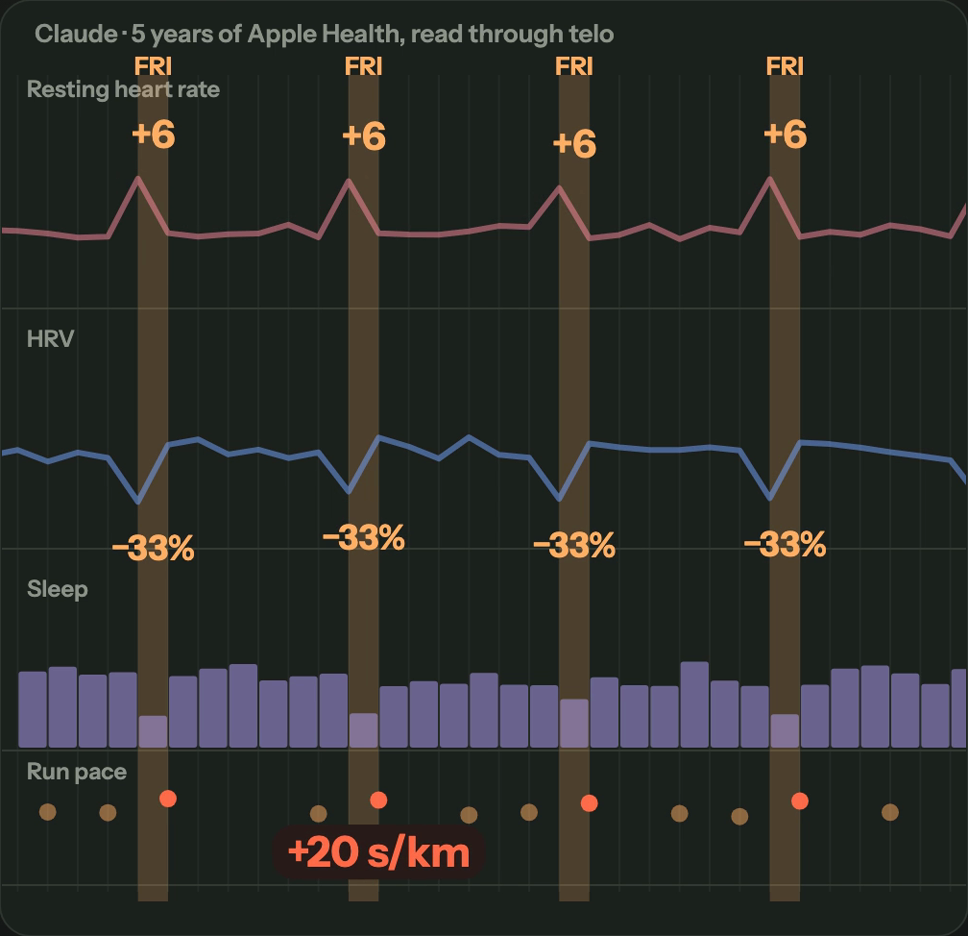
An assistant with years of your data can line those up. The example below is illustrative: Friday nights with resting heart rate 6 beats higher, HRV down a third, and Saturday's run 20 seconds per kilometre slower.
The prompt
Paste it into Claude or ChatGPT with telo connected. Starting from weekly summaries keeps the conversation light; the assistant pulls single days only to check a pattern.
Reading all your years is telo Pro. On the free plan the assistant sees your last 7 days, which is enough to try the prompt but too short for most patterns.
Using telo, look through my Apple Watch history as far back as you have it: sleep, resting heart rate, HRV and workouts. Start with weekly summaries and pull day-by-day data only where you need it. Find the 3 most surprising patterns that connect one thing to another (how I slept before a run and its pace, my resting heart rate rising before a bad week). Compare me with my own recent baseline. For each: one sentence, the numbers, how many times it happened and how sure you are. Say when it rests on fewer than 10 cases or could be coincidence. Save the most uncomfortable for last. Don't diagnose anything.What it tends to find
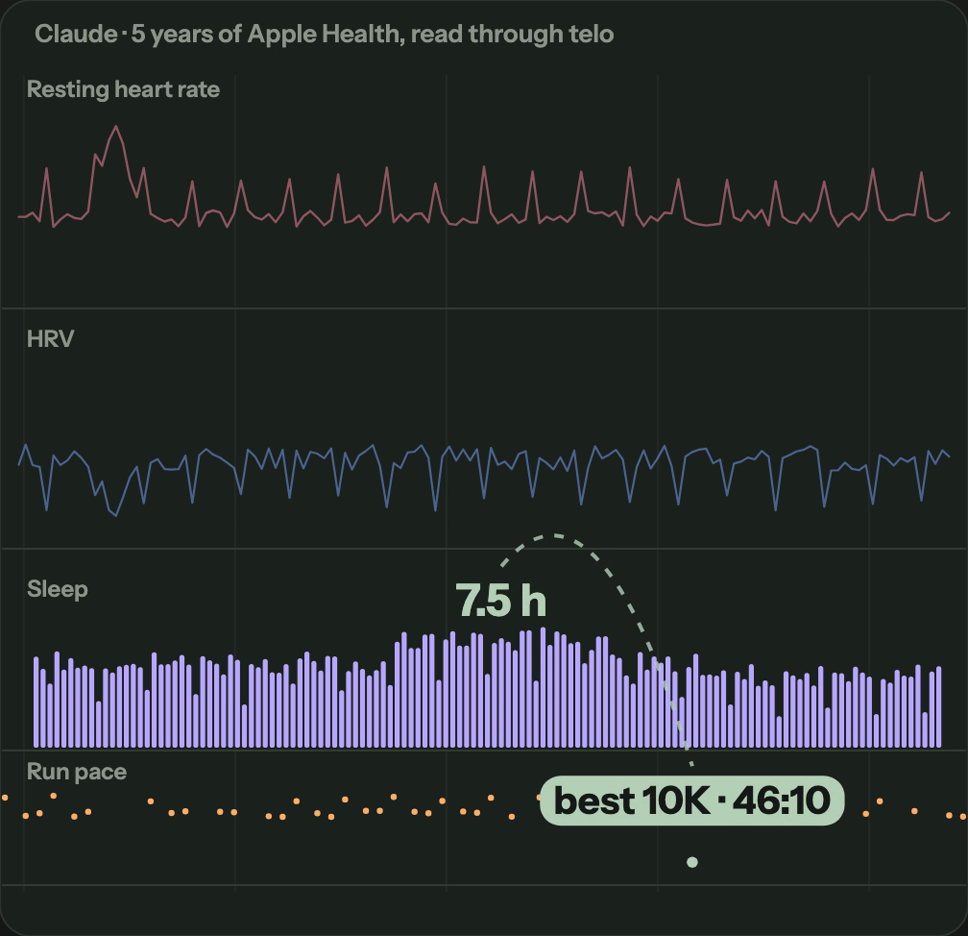
Patterns that connect a habit to an outcome: bedtime and next-day HRV, sleep before a run and that run's pace, time of day and heart rate at the same pace, a month of good sleep before your best race.
In our test it found three on one account: an earlier bedtime went with higher HRV and longer sleep; evening runs were faster at a lower heart rate than morning ones; and resting heart rate sat a little higher in the week before two long training breaks. It flagged the last one as resting on only 2 or 3 cases.
Resting heart rate before getting sick
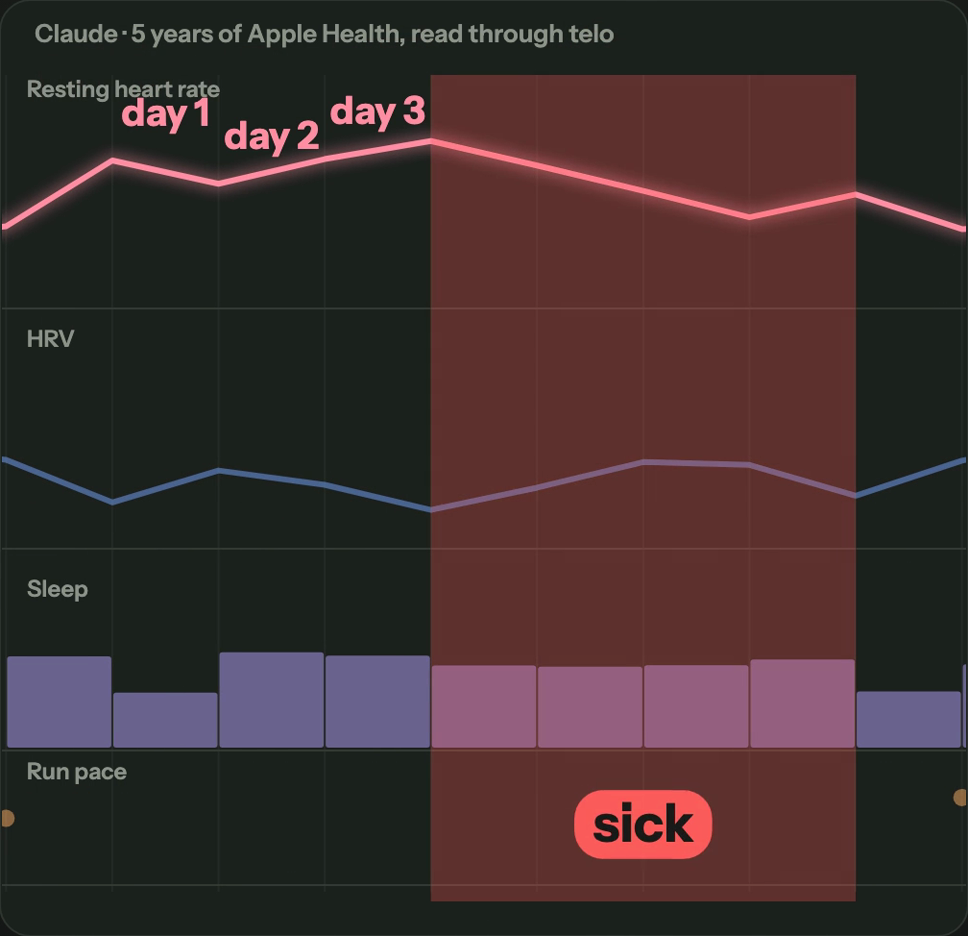
This is the one people find creepy, and it has research behind it. In a Stanford study of smartwatch data (Mishra et al., 2020), resting heart rate rose before symptoms in many COVID-19 cases; a later prospective study with real-time alerts flagged most cases at or before symptom onset.
It is a pattern, not a test. Training, heat, alcohol, stress and a new watch can all move resting heart rate. If the assistant sees it climbing for a few days, the useful reading is 'take it easy and watch it', not a diagnosis.
Where the data stops
Few cases make weak patterns, which is why the prompt asks for counts and says when something rests on fewer than 10. Comparing you with your own recent baseline avoids mistaking getting fitter over the years for a pattern.
Sensors change too. When a Washington Post reporter gave 10 years of data to ChatGPT, jumps at each watch upgrade were read as changes in his heart. Ask the assistant to check for that, and treat any grade or score as a conversation starter, not a verdict. This is not medical advice.
Practical questions
Why does it find so little on the free plan?
On the free plan the assistant sees only your last 7 days. Patterns like sleep before runs or resting heart rate before getting sick need months or years; reading your whole history is telo Pro.
Does a rising resting heart rate mean I'm getting sick?
Not necessarily. Smartwatch studies saw resting heart rate rise before symptoms in many cases, but training, heat, alcohol, stress and a new watch move it too. It is a signal to watch, not a diagnosis.
Does the prompt change anything in my account?
No. It only reads sleep, resting heart rate, HRV and workouts through telo and builds the answer in the conversation.
Sources and availability
Plans, regions and interfaces can change. Check the official sources before setting up.
- Mishra et al., 2020 · Pre-symptomatic detection of COVID-19 from smartwatch data · Nature Biomedical Engineering
- Alavi et al., 2021 · Real-time alerting system for COVID-19 and other stress events using wearable data · Nature Medicine
- MacRumors, 2026 · ChatGPT's Apple Health analysis graded one reporter's heart an F
How this guide was prepared
The prompt was tested on 9 November 2026 against one account, with the owner's permission, in a fresh assistant with only the telo tools. It worked end to end; the first version asked for 2 years of day-by-day data, which came to roughly 280,000 characters of raw data and is too heavy for a chat, so it now starts from weekly summaries. The charts in this guide come from Reel ep16 and use illustrative data, not a real person's. Prepared with AI assistance.