What happens when you start
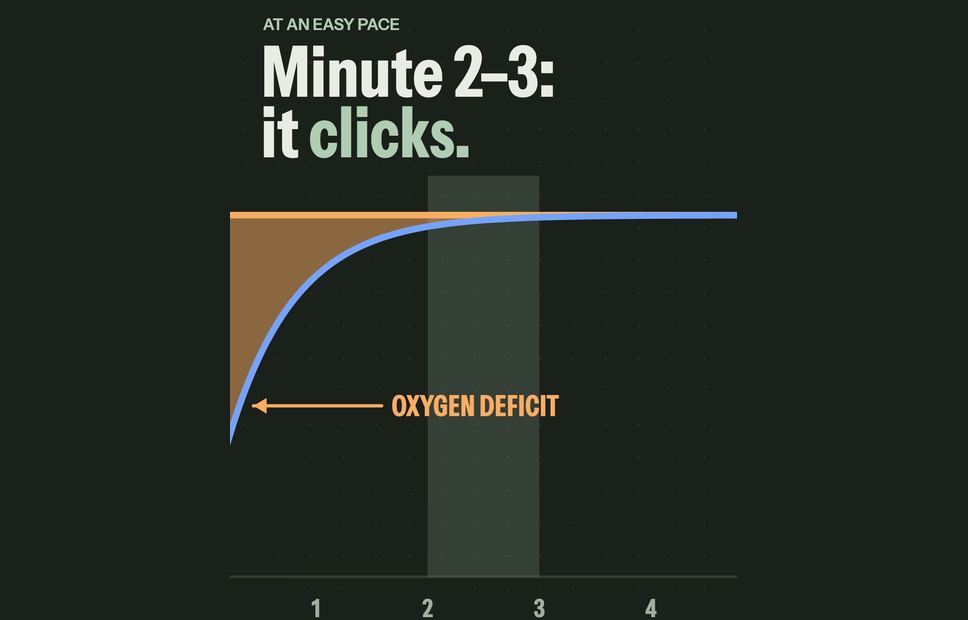
The moment you start running, your muscles need much more energy than at rest. The demand jumps almost instantly. Oxygen uptake doesn't: it rises along a curve and, at an easy pace, levels off after about 2 to 3 minutes.
The gap between what the muscles need and what oxygen covers is the oxygen deficit. During those minutes the muscles lean on fast, oxygen-free energy, and that's the heavy, breathless feeling.
Your heart has to speed up first
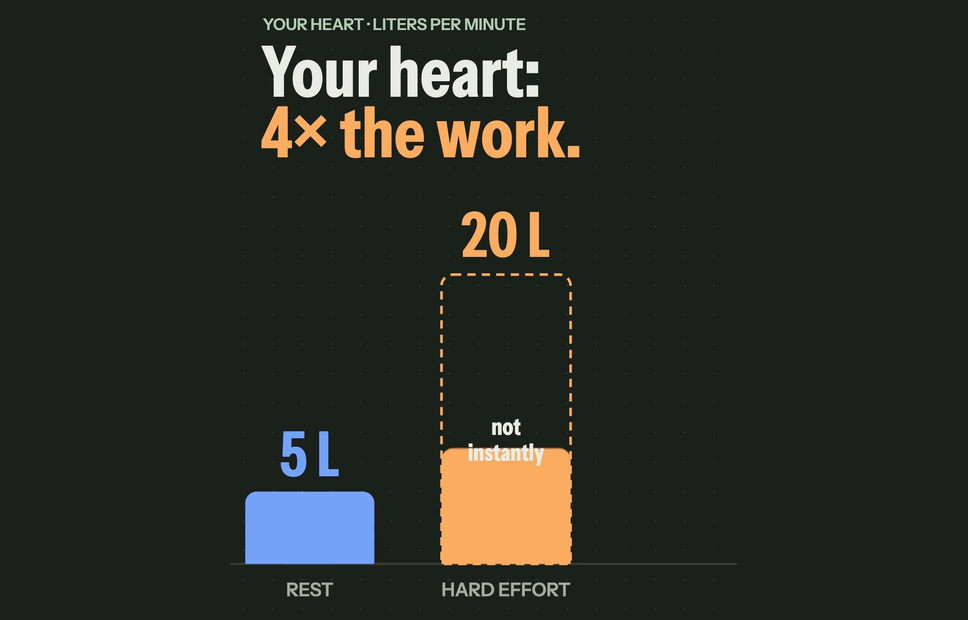
Part of the delay is delivery. A typical untrained adult's heart pumps about 5 liters of blood a minute at rest and up to about 20 in a hard effort; endurance athletes can pass 30. It can't jump from one to the other in a single beat.
That's why fitness changes how long the deficit lasts, not whether it exists. Even very fit runners have it.
The fix: a 5-minute ramp
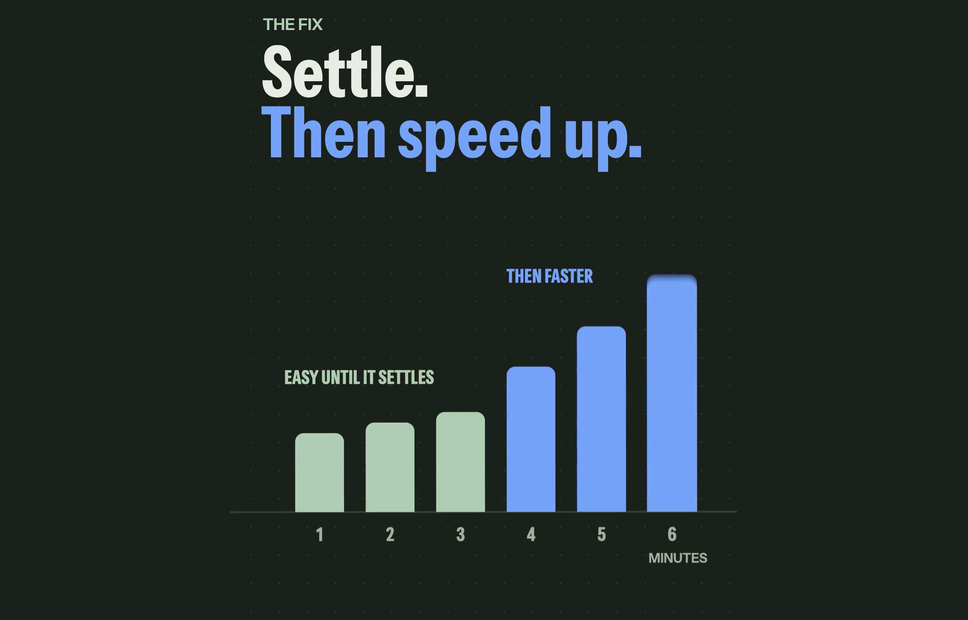
Starting slower than you want keeps the deficit small while oxygen catches up. Once your heart rate stops climbing fast, speeding up feels much easier. This applies at an easy pace: above your threshold, oxygen uptake keeps drifting up and never fully settles.
- Minutes 1 to 3: a pace at which you could talk in full sentences.
- Minutes 4 and 5: a bit faster.
- Then your normal run.
For any watch: see when your heart settles
Paste this into Claude or ChatGPT with your watch data, or export the first minutes of a few runs. It works with any watch or chest strap. The answer should give you a minute, usually between 2 and 4, and a ramp length that fits it.
Look at my last runs. For each, give me my average heart rate minute by minute for the first 10 minutes, and the minute it stopped climbing fast. Flag gaps or odd readings in the first minutes (wrist sensors are least reliable right at the start). Tell me if I started too fast, and suggest how long my easy ramp should be.On Apple Watch: let telo read it
With telo connected, this reads the heart rate series of your recent runs and creates the ramp as a planned workout. The first time, open telo on iPhone, go to Planned workouts and tap Schedule on Watch. Heart rate series are kept for 30 days, so ask about recent runs.
Using telo, show my heart rate minute by minute in the first 10 minutes of my runs from the last 30 days, then put a 5-minute ramp-up warm-up on my Watch with create_workout_plan.What the test showed
On one account, a run recorded with a chest strap showed exactly the textbook shape: heart rate rose fast until about minute 3 and then only drifted slowly. On a run with the watch alone, the first minute was empty and the early values looked locked near the running cadence (120 to 128, then 116) before settling.
That's why the prompt asks the AI to flag odd readings in the first minutes and to look at which device recorded the series. Wrist sensors are least reliable right at the start of a run.
Where the data stops
Heart rate is a stand-in for oxygen uptake, not a measure of it. Heat, caffeine, sleep, hills and stress all shift the first minutes, so compare runs under similar conditions.
This is not medical advice. Chest pain, dizziness or breathlessness that doesn't ease as you slow down is a reason to stop and talk to a doctor.
Practical questions
If the first minutes are hard, am I out of shape?
No. The oxygen deficit happens to everyone, including very fit runners. Fitness shortens how long it lasts, but it doesn't make it go away.
Does the ramp work before hard sessions too?
As a warm-up, yes, but the 2 to 3 minute rule is for an easy pace. Above your threshold, oxygen uptake keeps drifting up, so before intervals or a race the warm-up is usually longer.
Does the prompt create anything in my account?
The any-watch prompt doesn't use telo. The Apple Watch one reads the heart rate of your recent runs and creates the ramp as a planned workout in telo, which you schedule on your Watch and can cancel.
Sources and availability
Plans, regions and interfaces can change. Check the official sources before setting up.
- Poole & Jones, 2012 · Oxygen uptake kinetics · Comprehensive Physiology 2:933
- telo · Reel ep15 · 2026-11-10
How this guide was prepared
The any-watch prompt was tested on 9 November 2026 against one account, with the owner's permission: telo returned 11 runs from the last 30 days, all with a heart rate series, and the first 10 minutes of each came in 10-second buckets in one call per run. The create_workout_plan step of the telo prompt was not run in that test. The physiology follows Poole & Jones 2012; the charts come from Reel ep15 and are illustrative, without a value axis. Prepared with AI assistance.