What the study found
Tanaka, Monahan and Seals (2001, Journal of the American College of Cardiology) pooled 351 studies with 492 groups and 18,712 people. The line that fit max heart rate best was 208 − 0.7 × age, the same for men and women and regardless of how active people were.
They then measured max heart rate in a lab in 514 healthy adults and got almost the same line (209 − 0.7 × age). Their conclusion: 220 minus age underestimates max heart rate in older adults.

Why the gap grows after 40
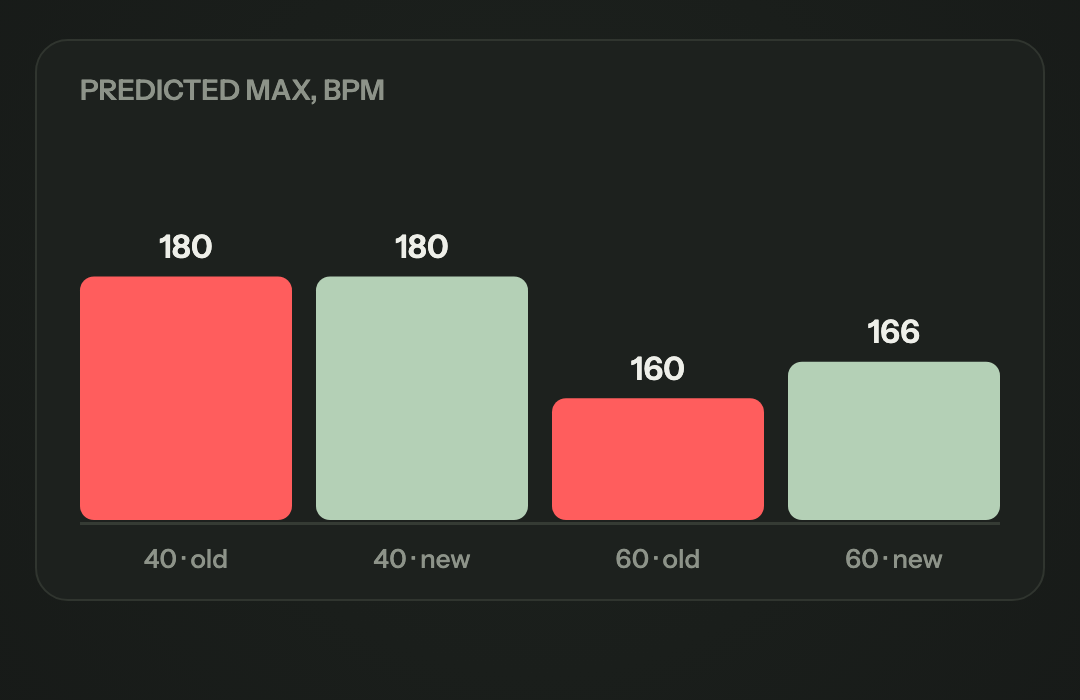
It is arithmetic. At 40 both formulas give 180. At 50 the old one says 170 and the new one 173. At 60 it is 160 against 166. Zones built on the old number sit a few beats too low, so an easy run can be logged as hard and a hard one as maximal.
Both formulas are still population averages. Your own max can sit well above or below either one, at any age. The best clue you have is the highest heart rate your watch has already recorded in a truly hard effort.
For any watch: your real max against both formulas
Paste this into Claude or ChatGPT with your watch data, and replace [AGE]. Asking for the top 5 instead of the single highest helps: if they cluster within a few beats in different hard workouts, the number is real; if one sits alone far above the rest, it is probably a glitch.
I'm [AGE] years old. From my workouts in the last 12 months, find the 5 highest heart rates recorded and the workouts they came from. Then compare the highest one with 220 − age and with 208 − 0.7 × age. Tell me which is closer, whether any reading looks like a sensor spike (a single jump with no effort around it), and what that means for my heart rate zones.On Apple Watch: let telo read it
With telo connected, the AI reads every workout's average and maximum heart rate straight from Apple Health. Apple Watch builds its zones from your max and resting heart rate; you can set them by hand on the watch in Settings, Workout, Heart Rate Zones, where Automatic can be switched to Manual.
Using telo, I'm [AGE]. Find the highest heart rates in my workouts from the last 12 months, flag any that look like sensor spikes, and compare my real max with 220 − age and 208 − 0.7 × age. Then tell me what my zones would look like with each.What the test showed
On one account, telo returned 12 months of workouts with average and maximum heart rate for each. A year of workouts is more than one answer holds, so the AI asked for it in smaller date ranges; with fewer workouts it comes back in one go.
The top readings clustered: 177, 176 and four at 175 bpm, from five runs and one long ride, all with a high average heart rate across the whole workout (147 to 164 bpm). Nothing stood alone, so none looked like a sensor spike. For workouts older than 30 days only the summary is kept, not the heart rate series, so the spike check there leans on the average and on how many hard sessions agree.
Where the data stops
The formulas come from healthy adults not taking medicine that changes heart rate. Beta blockers and some other drugs lower max heart rate, and then neither formula applies. The highest heart rate in your workouts is only your max if you ever went truly all out; if you never did, the real max is higher.
Wrist sensors can lag or jump during intervals, so one reading is weak evidence. Several hard workouts that agree are much stronger. This is not medical advice, and a max heart rate test should only be done if you are cleared for hard exercise.
Practical questions
Which formula should I use?
If you have no hard workouts recorded, 208 − 0.7 × age is the better average, especially after 40. If you do, the highest heart rate from several truly hard efforts that agree beats either formula.
Why is my recorded max higher than both formulas?
Because the formulas are averages, and plenty of people sit 10 or more beats above them. A high recorded max is not a problem by itself; check that it shows up in more than one hard workout.
Does Apple Watch use 220 minus age?
Apple does not publish the exact formula. Its automatic zones use your max and resting heart rate from Health, and you can switch to manual zones in the Workout settings on the watch if you know your own max.
Sources and availability
Plans, regions and interfaces can change. Check the official sources before setting up.
How this guide was prepared
The Apple Watch prompt was tested on 11 November 2026 against one account, with the owner's permission, using only telo's read tools: every workout from the last 12 months with its average and maximum heart rate. The numbers come from Tanaka, Monahan & Seals 2001; the images are frames from Reel ep20. Prepared with AI assistance.