What the study found
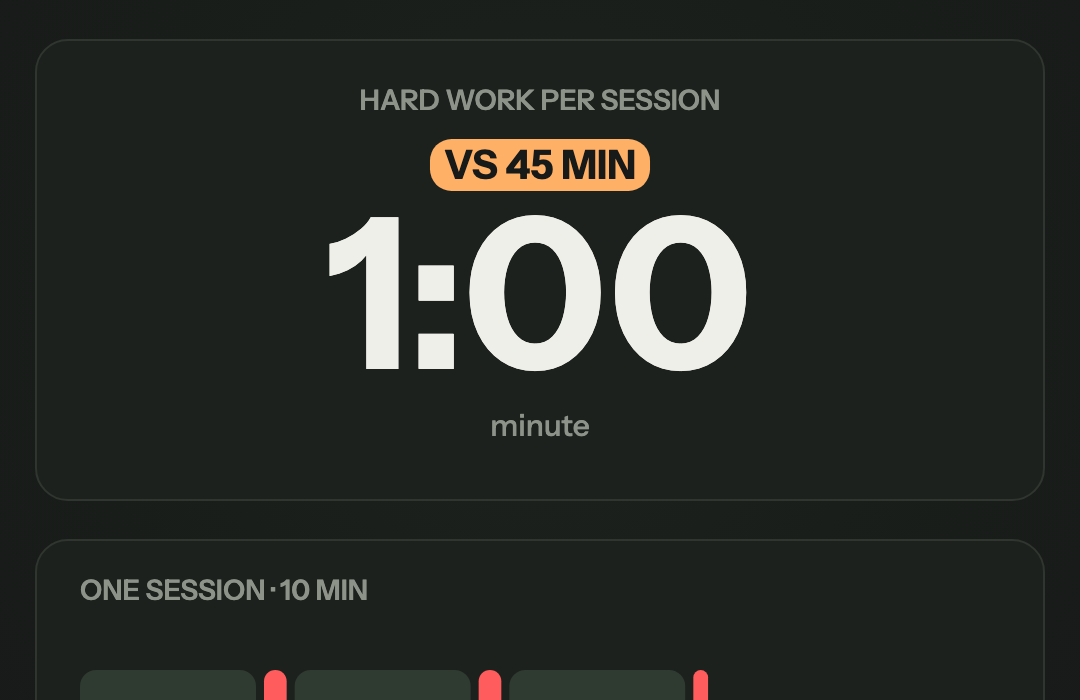
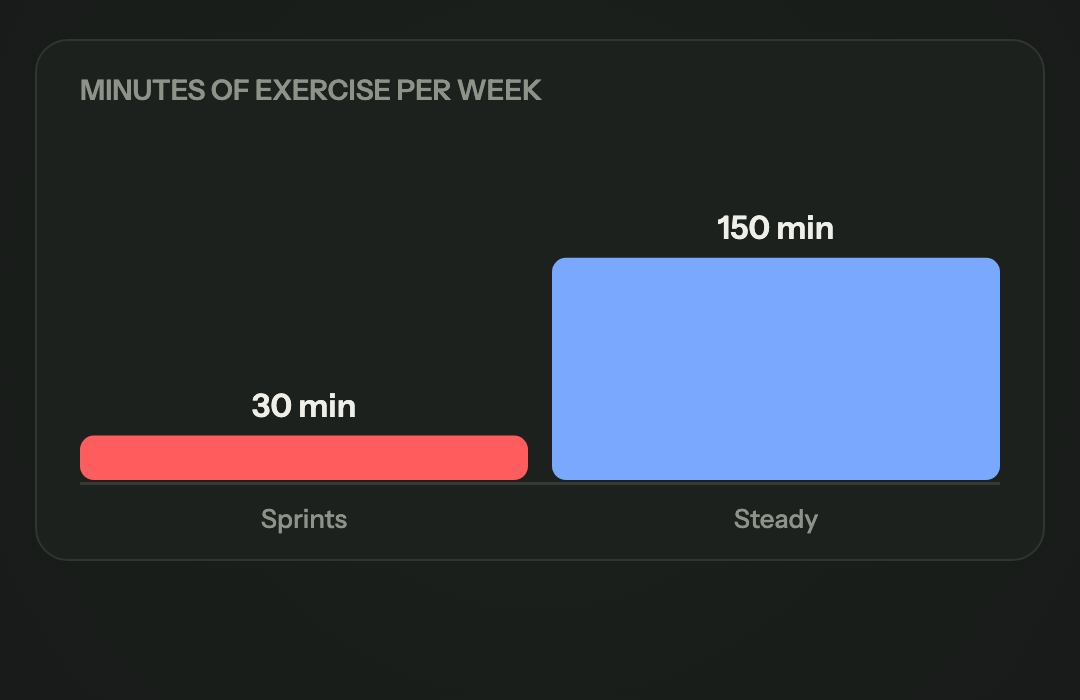
Gillen and colleagues (2016, PLOS ONE) took 27 sedentary men and had them ride a stationary bike 3 times a week for 12 weeks. One group (n = 9) did 3 sprints of 20 seconds, all out, inside a 10-minute session with warm-up and cool-down: 30 minutes a week. Another group (n = 10) rode 45 minutes at about 70% of max heart rate: 150 minutes a week. A third group did nothing.
Both training groups raised their VO2 peak by about 19%. Insulin sensitivity and muscle mitochondrial capacity also improved by similar amounts. One minute of hard work per session, a fifth of the weekly time.
The session
10 minutes in total, 3 times a week. All out means the hardest you can go for those 20 seconds, not a pace that feels pretty hard. On a bike, that was a high resistance and maximum cadence. Running sprints, hill sprints or a rowing machine are common swaps, but they were not what the study tested.
- 2 minutes easy.
- 20 seconds all out.
- 2 minutes easy.
- 20 seconds all out.
- 2 minutes easy.
- 20 seconds all out.
- 3 minutes easy.
For any watch: is it working?
Paste this into Claude or ChatGPT with your watch data. Give it at least 4 weeks after you start: in the study the gains were measured at 12 weeks, and a week or two of readings moves more from sleep, heat and noise than from training.
I started 20-second sprint sessions on [DATE]. Compare the 4 weeks before and the weeks since: my resting heart rate per week, my heart rate on easy runs or rides at the same pace, and my VO2 max readings. Tell me what moved and how sure we can be with this much data.On Apple Watch: let telo set it up
With telo connected, this creates the session as a planned workout and reads your weekly baseline. The first time, open telo on iPhone, go to Planned workouts and tap Schedule on Watch. Run the second half again after 4 weeks to compare.
Using telo, put a workout on my Watch: 2 min easy, then 3 rounds of 20 s all out and 2 min easy, then 3 min easy, with create_workout_plan. Then show my resting heart rate and VO2 max per week for the last 8 weeks.What the test showed
On one account, the read part of the prompt returned 8 full weeks of resting heart rate (7 days in each week) and VO2 max (5 to 7 readings a week), plus every run with average and max heart rate. That's enough for a before and after baseline.
Weekly resting heart rate on that account moved only between 48.7 and 51.4 bpm across 8 weeks, so a real change from training would need to be bigger than that swing to stand out. The create_workout_plan step was not run in the test.
Where the data stops
The study was small (9 and 10 people per group), only men, only sedentary, only cycling. Trained people, women and runners were not tested, so treat it as a starting point, not a promise. VO2 max on Apple Watch is an estimate from outdoor walks and runs, not a lab test.
All-out sprints are hard on the heart. If you have a heart condition, are new to exercise or feel chest pain, dizziness or unusual breathlessness, talk to a doctor first. This is not medical advice.
Practical questions
Is one minute a day enough?
The study used 3 sessions a week of 10 minutes each, with one minute of all-out effort inside each session. It did not test one minute a day or skipping the easy minutes.
Can I do the sprints running instead of on a bike?
Many people do, but the study used a stationary bike. Running sprints add impact and are harder to make truly all out safely; a hill or a bike is a gentler start.
How long until I see a change?
The study measured at 12 weeks. Check your resting heart rate and VO2 max trend after 4 weeks at the earliest, and compare weekly averages, not single days.
Sources and availability
Plans, regions and interfaces can change. Check the official sources before setting up.
How this guide was prepared
The read part of the Apple Watch prompt was tested on 10 November 2026 against one account, with the owner's permission: telo returned 8 weeks of weekly resting heart rate and VO2 max and the runs of the last two weeks with heart rate. The create_workout_plan step was not run in that test. The numbers come from Gillen et al. 2016; the images are frames from Reel ep18. Prepared with AI assistance.