What the study found
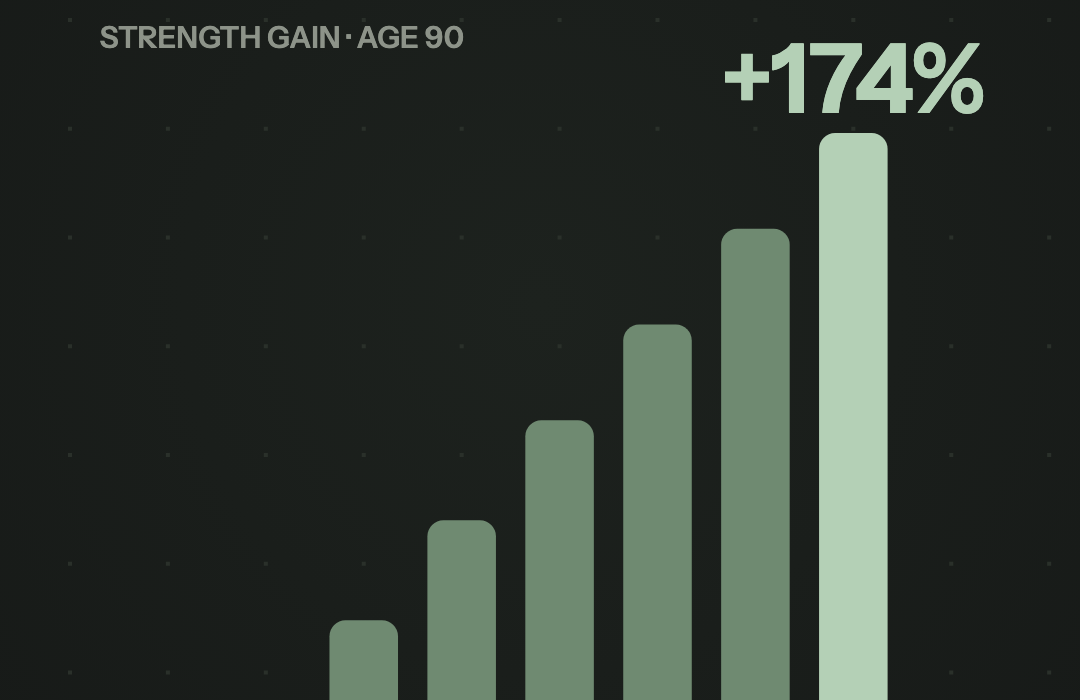
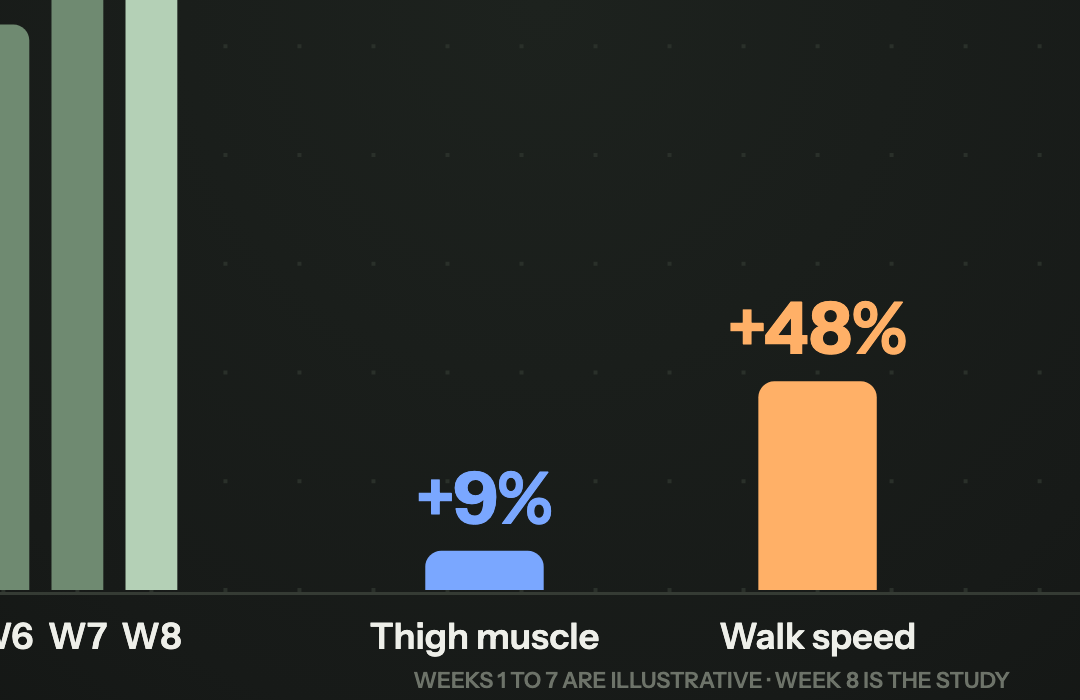
Fiatarone and colleagues (1990, JAMA) trained 10 volunteers living in a nursing home, aged 90 plus or minus 1 year, with high-intensity strength training of the legs for 8 weeks. Nine finished.
Their strength went up 174% on average (plus or minus 31%). The muscle area of the thigh grew 9%, and their speed on a heel-to-toe walking test went up 48%.
What counts is how often
The WHO 2020 guidelines (Bull et al., Br J Sports Med) recommend muscle-strengthening activities at moderate or greater intensity on 2 or more days a week for adults. For people 65 and older, the same applies, plus varied activity that trains balance and strength on 3 or more days a week.
That turns a vague goal into something you can count: how many weeks in a row had at least two strength sessions.
For any watch: count your strength weeks
Paste this into Claude or ChatGPT with your watch data. The streak says more than the average: two sessions most weeks with a gap of three weeks in the middle is a different habit from two sessions every week.
Look at my workouts from the last 12 weeks. Count only strength sessions (traditional or functional strength training, core training, and similar). For each week, tell me how many strength sessions I did and how many minutes. Then tell me how many of those 12 weeks reached 2 or more strength sessions, which is the WHO guideline for adults, and what my longest streak of weeks at 2+ was. Don't judge, just count, and suggest which 2 days of my week would fit strength best based on when I already train.On Apple Watch: let telo read it
With telo connected, the AI reads the workouts your watch saved in Apple Health, with date, time and length, without you exporting anything.
Using telo, count my strength workouts per week over the last 12 weeks, how many weeks hit 2 or more, my longest streak, and which 2 days of my week fit strength best.What the test showed
On one account, telo grouped traditional strength, functional strength and core sessions together and returned them week by week in a single answer. Across 12 weeks the counts were 2 or 3 sessions a week, about 40 to 57 minutes each, so all 12 weeks reached 2 or more and the streak was the full 12.
Asked per session, telo also returned the date and start time of each workout. The strength sessions sat on Monday, Wednesday and Friday afternoons, with runs in the morning and rides in the evening, which is what the AI needs to suggest which days fit.
Where the data stops
The 1990 study had 10 people, all frail and living in a nursing home, with no control group, so it shows what is possible, not what to expect. The percentages are averages over 9 people with a wide spread.
Your watch only knows the sessions you started as a workout. Lifting you did without starting one is invisible, and the watch cannot tell how heavy the weights were, so the count says how often, not how hard. This is not medical advice; talk to your doctor before starting heavy training, especially if you have a heart condition or have been inactive.
Practical questions
Is it really safe to start lifting at 90?
This study does not answer that for everyone: it was 10 people in a nursing home, training under supervision, and one of the ten did not finish. Start with a doctor's OK and, ideally, someone who can coach the technique.
Does yoga or pilates count as strength?
The WHO guideline counts muscle-strengthening activity at moderate or greater intensity. Some yoga and pilates sessions qualify, some do not. The prompts count what your watch logged as strength or core training, so if you want those sessions to count, log them that way.
Why weeks and not total sessions?
The guideline is per week, and a streak shows whether the habit holds. Twenty sessions in 12 weeks can mean 2 every week or 5 a week for a month and then nothing.
Sources and availability
Plans, regions and interfaces can change. Check the official sources before setting up.
- Fiatarone et al., 1990 · High-intensity strength training in nonagenarians · JAMA
- Bull et al., 2020 · World Health Organization 2020 guidelines on physical activity and sedentary behaviour · Br J Sports Med
How this guide was prepared
The Apple Watch prompt was tested on 12 November 2026 against one account, with the owner's permission, using only telo's read tools: workouts per week and per session over 12 weeks. The numbers come from Fiatarone et al. 1990 and Bull et al. 2020; the images are frames from Reel ep21. Prepared with AI assistance.