What the studies found
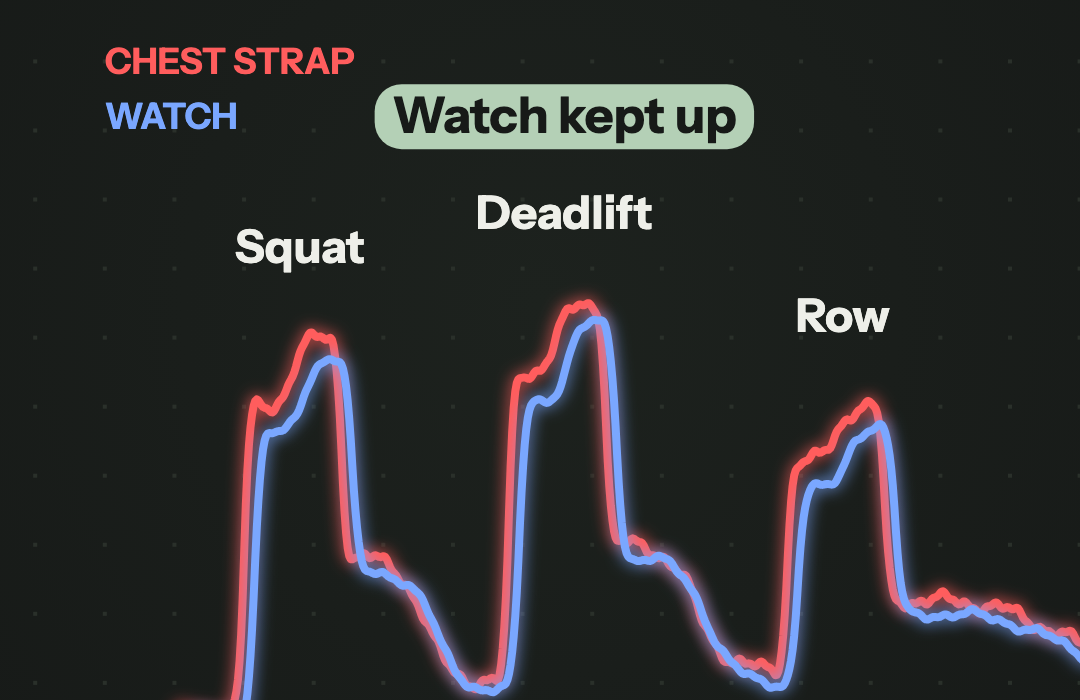
Støve and Hansen (2022, Journal of Sports Sciences) put an Apple Watch Series 6 and a Whoop 3.0 on 29 young adults and compared both with a Polar H10 chest strap during squats, deadlifts, curl to press, seated rows and burpees. The Apple Watch agreed well with the strap on squats, deadlifts and rows, and only moderately to poorly on curl to press and burpees, the moves where the wrist bends and swings.
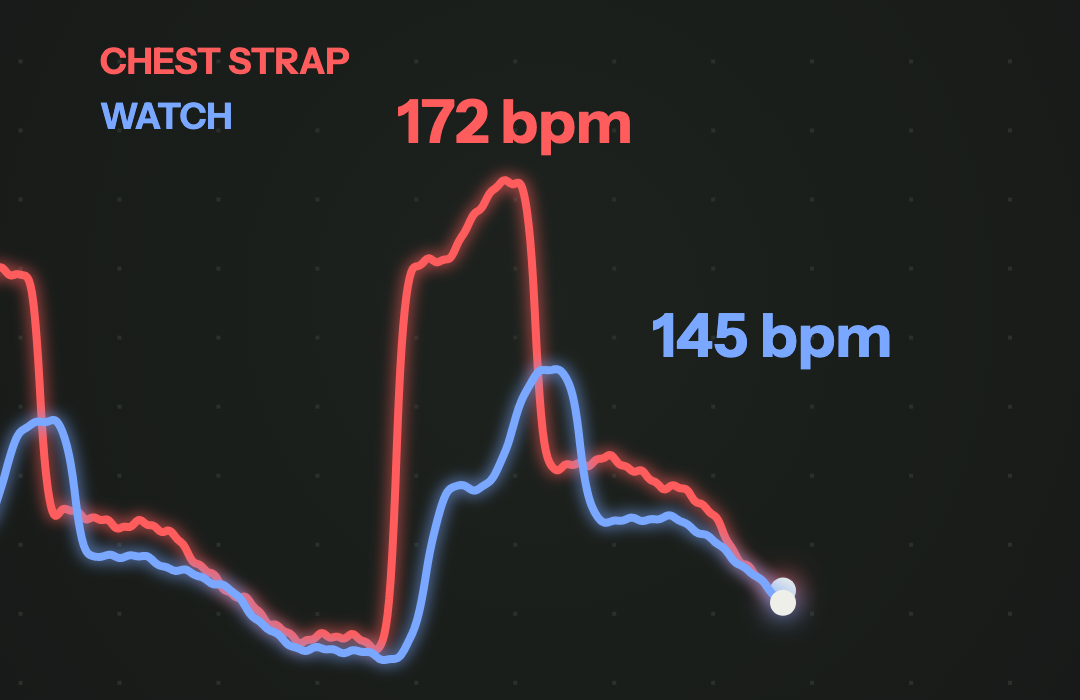
An older study (Boudreaux and colleagues, 2018, Medicine and Science in Sports and Exercise) tested eight heart rate devices against ECG on a bike and in sets of resistance exercise. In every device, the higher the intensity, the more heart rate was underestimated.
Which lifts the wrist reads well
On squats, deadlifts and rows the wrist stays fairly still and the grip is steady, and the watch line tracked the strap closely. On curl to press and burpees, the wrist flexes, swings and changes position every rep, and agreement dropped.
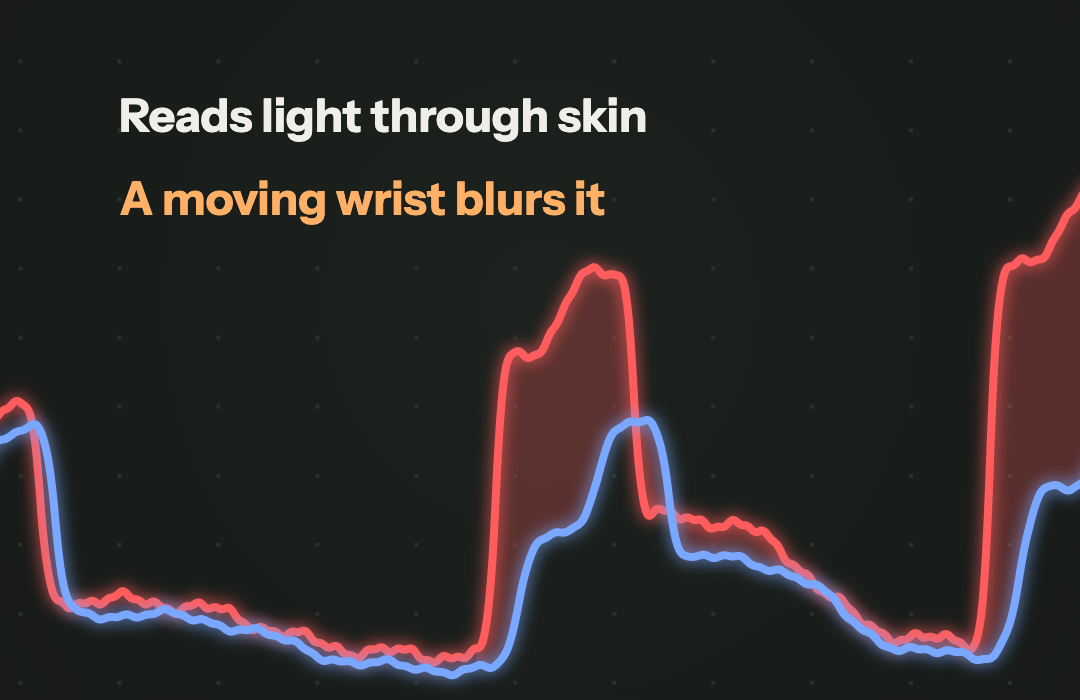
The watch is not broken. It reads light through your skin, and a moving, flexing wrist blurs that signal. During a set the reading can lag behind the real rise and miss the peak, then catch up during rest.
For any watch: flag suspicious lifting sessions
Paste this into Claude or ChatGPT with your watch data. Comparing with your cardio in the same weeks gives the AI a reference: if your lifting max sits far below your running max every time, part of that gap can be the sensor, not the effort.
Look at my strength training workouts from the last 8 weeks. For each, give me average and max heart rate, and compare them with my runs or walks in the same weeks. Flag strength sessions where heart rate looks suspicious: flat for long stretches, sudden short spikes, or a max far below what I reach in cardio. Remind me that wrist sensors read low during hard, wrist-heavy moves, and tell me which numbers to trust.On Apple Watch: let telo read it
With telo connected, the AI reads every workout's average and maximum heart rate straight from Apple Health, and for the last 30 days it can open the heart rate series of a session to look for flat stretches and spikes. Older workouts keep only the summary.
Using telo, compare average and max heart rate of my strength workouts with my runs over the last 8 weeks, and flag strength sessions with suspicious heart rate (flat stretches, short spikes). Only the last 30 days have minute-by-minute series.What the test showed
On one account, telo returned 8 weeks of workouts: 19 strength sessions and 18 runs, all recorded by an Apple Watch. Strength sessions averaged 83 to 101 bpm with a max of 115 to 152; runs averaged 126 to 151 with a max of 139 to 172. The lifting max sat 20 to 40 beats under the running max in the same weeks, which is exactly the pattern the prompt asks the AI to flag.
The heart rate series of one recent session showed clear peaks of 120 to 134 bpm per set and drops to about 70 between sets, with a few short gaps without samples and no long flat stretch. That is a believable trace, so the useful number there is the session average, not the peak of one set.
Where the data stops
The 2022 study had 29 young adults and one Apple Watch model; the 2018 study used devices from 2017. Newer watches may do better, and your own fit, skin and wrist position change the reading. Neither study gives a single number for how many beats the watch misses.
A lower max in lifting than in running is also normal on its own: a set is short and the effort is different. The prompt can only tell you a session looks suspicious, not what your heart rate really was. If you need the real peak of a set, wear a chest strap. This is not medical advice.
Practical questions
Should I trust my watch's heart rate zones when lifting?
Use them loosely. For squats, deadlifts and rows the wrist tracks a chest strap fairly well. For moves where the wrist bends or swings, like curl to press and burpees, expect the watch to read low and late, and look at the session average rather than the peak of one set.
Why is my max heart rate lower in the gym than on runs?
Partly because a set is short and the effort is different, and partly because wrist sensors read low during hard, wrist-heavy moves. If you want to know how much is the sensor, wear a chest strap for one session and compare.
Does a chest strap fix it?
Mostly. A chest strap reads the heart's electrical signal instead of light through the skin, so wrist movement matters much less. Apple Watch can pair with a Bluetooth chest strap and use it during workouts.
Sources and availability
Plans, regions and interfaces can change. Check the official sources before setting up.
- Støve & Hansen, 2022 · Accuracy of the Apple Watch Series 6 and the Whoop Band 3.0 for heart rate monitoring during resistance exercises · J Sports Sci
- Boudreaux et al., 2018 · Validity of wearable activity monitors during cycling and resistance exercise · Med Sci Sports Exerc
How this guide was prepared
The Apple Watch prompt was tested on 13 November 2026 against one account, with the owner's permission, using only telo's read tools: every workout from the last 8 weeks with its average and maximum heart rate, and the heart rate series of one recent strength session. The study numbers come from Støve & Hansen 2022 and Boudreaux et al. 2018; the images are frames from Reel ep24 and the lines in them are illustrative. Prepared with AI assistance.