The five sessions
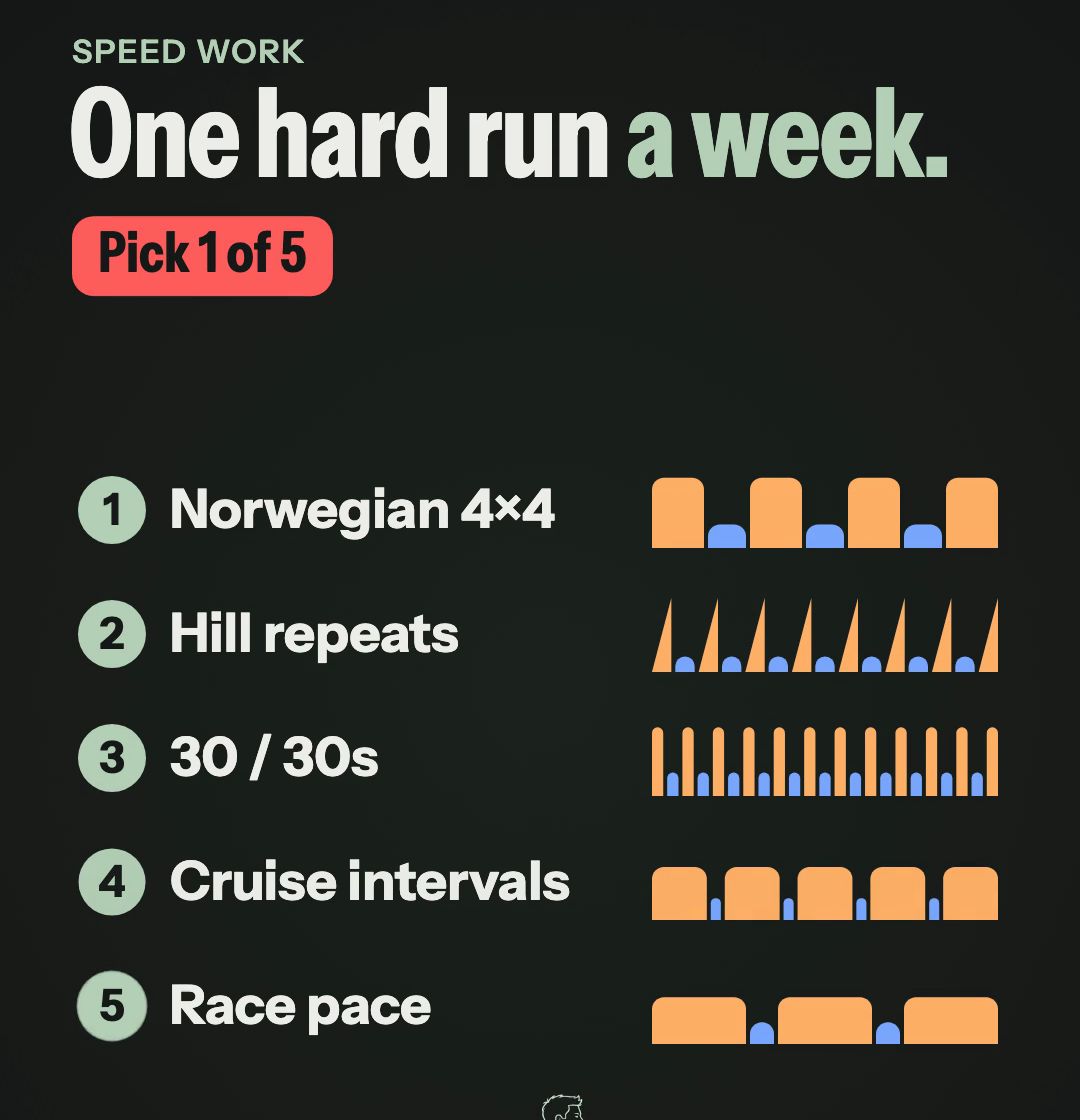
Pick one this week. If you run three to five times a week, that single session is your hard day and every other run is easy enough to talk in full sentences.
| Session | Recipe | What it trains |
|---|---|---|
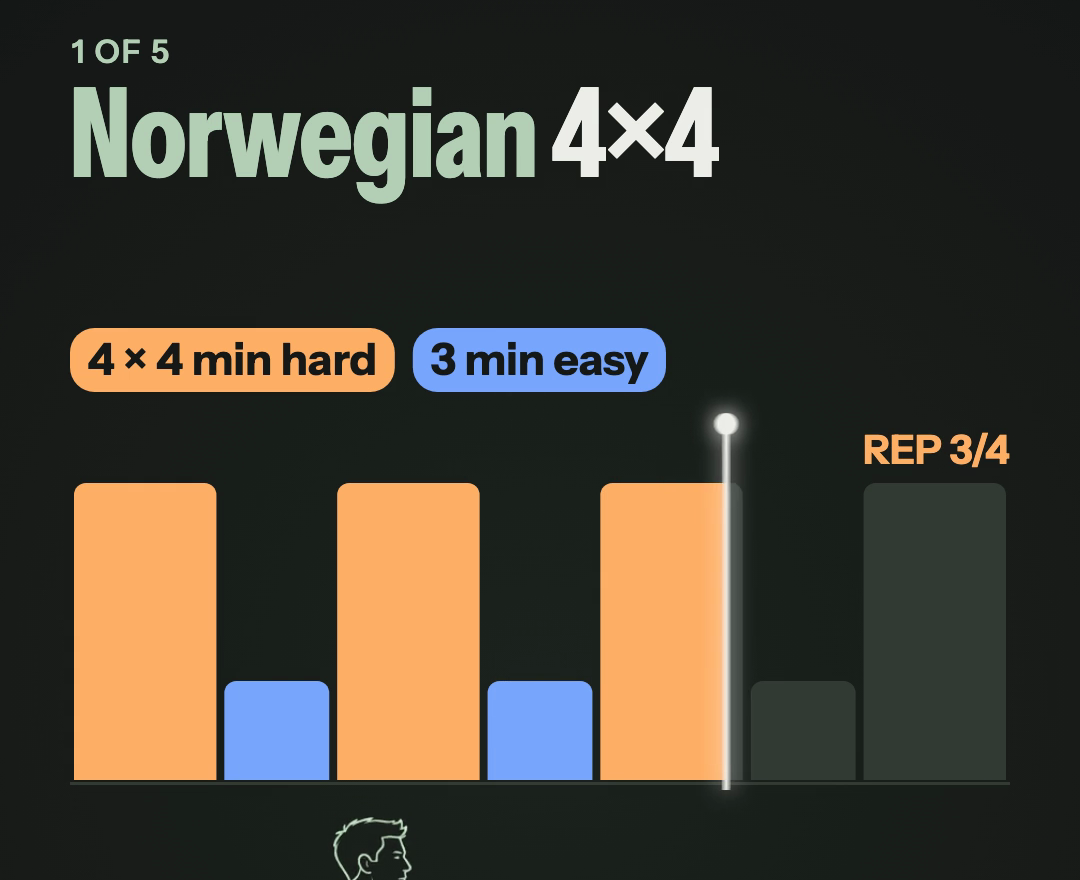
| Norwegian 4×4 | 4 × 4 min hard, 3 min easy jog between | VO2 max |
| Hill repeats | 8 × 60 s uphill, jog back down | Leg power |
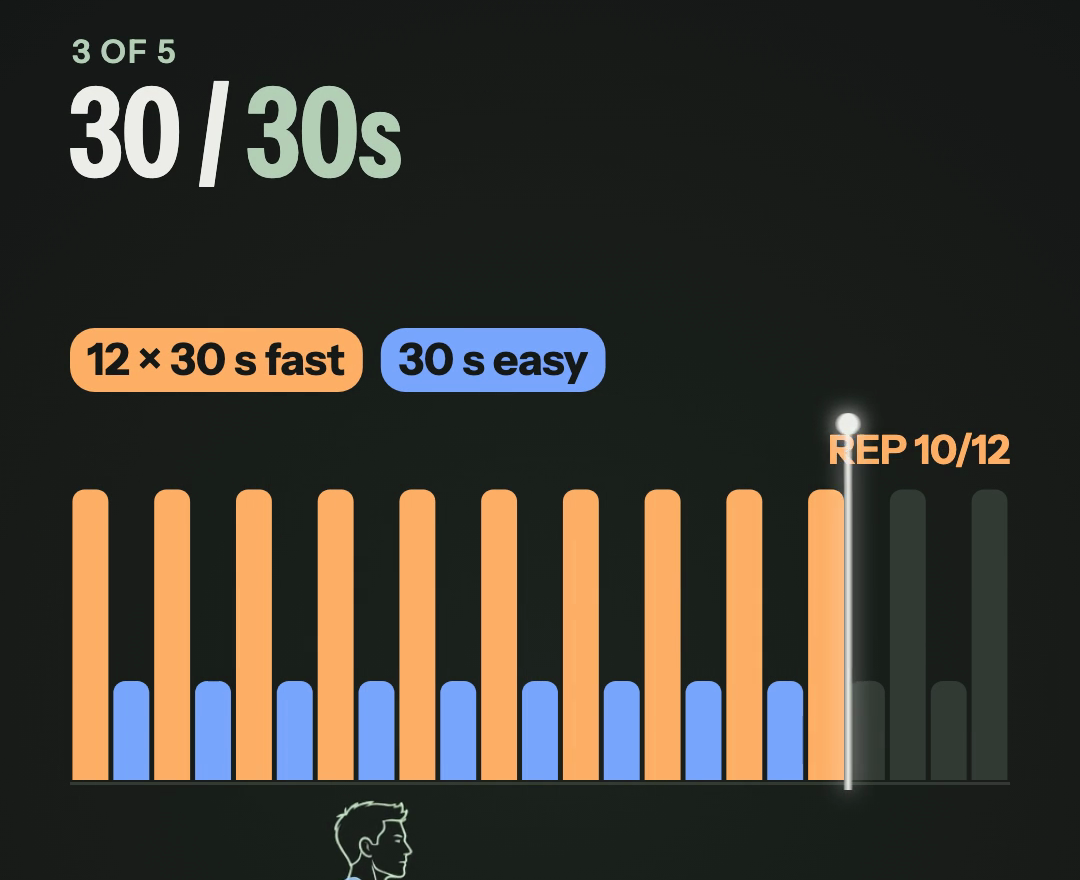
| 30/30s | 12 × 30 s fast, 30 s easy | Time at VO2 max |
| Cruise intervals | 5 × 1 km comfortably hard, 1 min jog | Threshold |
| Race pace | 3 × 3 km at goal pace, 2 min jog | Holding your race pace |
What the evidence says
The 4×4 has the strongest study behind it. Helgerud and colleagues (2007, Medicine and Science in Sports and Exercise) trained 40 moderately trained men for 8 weeks. The group doing 4 × 4 minutes at 90 to 95% of maximum heart rate raised VO2 max by 7.2%; the groups running the same total work at easy or threshold pace did not improve it. The study had only young men and lasted 8 weeks.
For 30/30s, Billat and colleagues (2000, European Journal of Applied Physiology) measured 8 long-distance runners on a track. Alternating 30 seconds at the speed of VO2 max with 30 seconds at half that speed kept them at VO2 max for 7 min 51 s on average, against 2 min 42 s in a hard continuous run. This is one session in 8 runners; the paper says it does not show what months of this training do.
Cruise intervals come from Jack Daniels' Running Formula: repeats at threshold pace with about 1 minute of rest for every 5 minutes of running. Hill repeats and race-pace blocks are coaching practice, with no study quoted here.
Why one hard run and not three
Seiler (2010, International Journal of Sports Physiology and Performance) reviewed how national and international endurance athletes train: about 80% of their sessions are at low intensity and about 20% are hard. For someone who runs up to five times a week, 20% is one session.
That is our reading of a review of elite athletes who train 10 to 13 times a week, not a trial in recreational runners. If you run six or more times a week, two hard days can fit.
For any watch: pick this week's session
Paste this into Claude or ChatGPT with your run log from any watch or app. It answers the question most runners skip: how many of last month's runs were really hard.
I want one hard run this week. Here are my runs from the last 4 weeks: [paste them]. Count my runs per week and how many of them were hard. Then pick one of these five sessions for this week and say why: Norwegian 4x4 (4 x 4 min hard, 3 min easy), hill repeats (8 x 60 s uphill), 30/30s (12 x 30 s fast, 30 s easy), cruise intervals (5 x 1 km comfortably hard, 1 min jog), race pace (3 x 3 km at goal pace). Write it out with a 10 min warm-up, each rep and recovery, and a 5 min cool-down.Send this week's hard run to your Apple Watch
With telo connected, your assistant reads every run your Apple Watch saved to Apple Health, grouped by week, with the time spent in each heart rate zone. It picks the session from what you actually ran and creates the workout, which shows up in the Workout app on your watch with each step ready to start.
Four weeks in the conversation is part of telo Pro; on Free, the assistant sees the last 7 days, which answers whether this week already has its hard run.
To look at the same weeks yourself, the Health tab of telo on the web opens your workouts in any browser. See how in the guide to Apple Health on a Mac or PC.
Using telo, look at my runs from the last 4 weeks: runs per week and time above 80% of my max heart rate. Pick one of these five sessions for this week and say why: Norwegian 4x4, hill repeats, 30/30s, cruise intervals or race pace. Then create it as a workout on my Apple Watch for Thursday, with a 10 min warm-up, every rep and recovery, and a 5 min cool-down.What the test showed
On one account, telo returned the runs from 26 October to 18 November 2026 grouped by week: 2, 3, 2 and 2 runs, from 13.3 to 25.1 km per week. Time above 80% of the highest heart rate seen in those runs (181 bpm) was under 1 minute in the first week, 51 minutes in the second, 12 in the third and 24 in the fourth.
So the answer to how much hard running there was came back for every week, and it moved a lot from one week to the next. Up to about 9 minutes per week had no heart rate samples, and the answer says so. This is one person's log and it shows that the answer comes back complete; it says nothing about how that person should train.
How to read your answer
This reads your own training log. It is not medical advice. If you are new to hard running or have a health condition, talk to a professional first.
- Look at the weeks with no hard running, and the weeks with two or three hard runs. Both are worth changing.
- Put the hard run at least a day away from your long run.
- Rotate. Do not repeat the same session every week, and never do all five in one week.
- If the session feels impossible on the day, cut the number of reps, not the recoveries.
Practical questions
How many interval sessions should I run per week?
One, if you run up to about five times a week. Elite endurance athletes do about 80% of their sessions easy and 20% hard (Seiler, 2010), and 20% of five runs is one. That is a reading of how elites train, not a trial in recreational runners; with six or more runs a week, two hard days can fit.
Which interval session is best for VO2 max?
The Norwegian 4×4 has the strongest evidence: in 40 moderately trained men, 8 weeks of 4 × 4 minutes at 90 to 95% of maximum heart rate raised VO2 max by 7.2% (Helgerud et al., 2007). 30/30s also keep you at VO2 max for a long time in a single session (Billat et al., 2000, 8 runners).
Can ChatGPT or Claude put an interval workout on my Apple Watch?
With telo, yes. Claude and ChatGPT read the runs your Apple Watch saves to Apple Health and create a custom workout that appears in the Workout app on the watch, with warm-up, reps, recoveries and cool-down as steps.
Sources
- Helgerud et al., 2007 · Aerobic high-intensity intervals improve VO2max more than moderate training · Medicine and Science in Sports and Exercise
- Billat et al., 2000 · Intermittent runs at the velocity associated with maximal oxygen uptake enables subjects to remain at maximal oxygen uptake for a longer time than intense but submaximal runs · European Journal of Applied Physiology
- Seiler, 2010 · What is best practice for training intensity and duration distribution in endurance athletes? · International Journal of Sports Physiology and Performance
How this guide was prepared
The Apple Watch prompt was tested on 18 November 2026 against one account, with the owner's permission, using only telo's read tools: the data status and the runs grouped by week from 26 October to 18 November 2026. The abstracts of Billat 2000 and Seiler 2010 were checked on 18 November 2026; the Helgerud 2007 numbers were checked for our 4×4 guide. The cruise interval recipe follows the 5 to 1 work to rest ratio of Daniels' Running Formula. The images are frames from Reel ep36, with illustrative bar heights. Prepared with AI assistance.