Three things the number does not tell you
- It only measures while you sleep. The watch samples every 5 seconds during sleep, so a night without the watch, or without sleep tracking, has no reading.
- It needs about 5 nights to learn your normal. Apple builds your baseline after roughly 5 nights with Sleep Focus on for at least 4 hours.
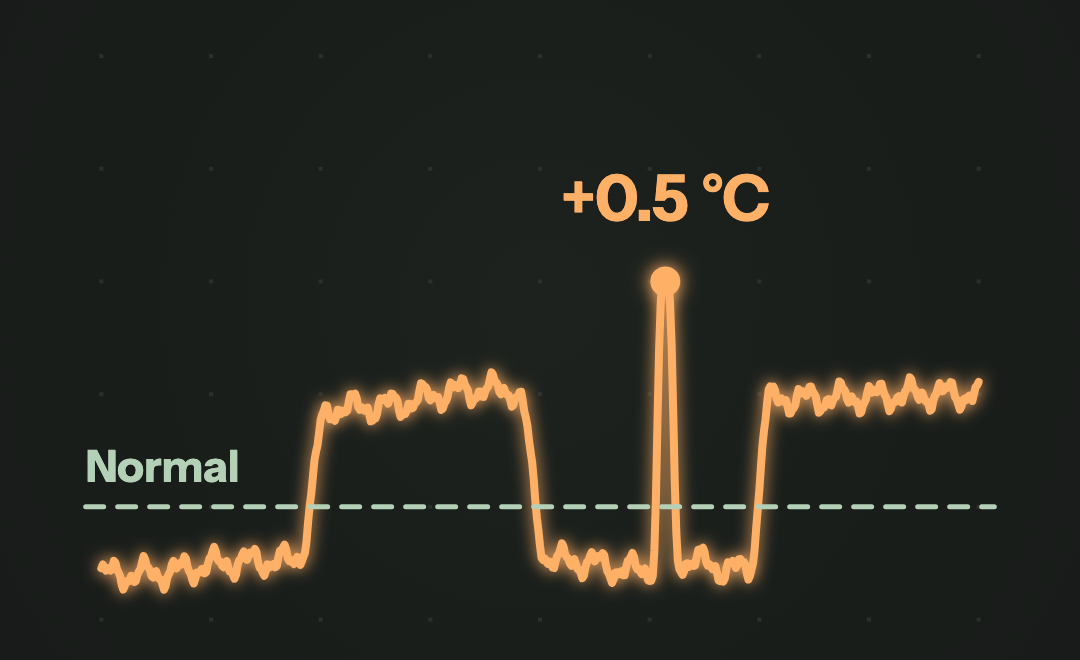
- It is not your temperature. The Health app shows the change from your baseline. Half a degree up means warmer than usual, not a fever.
What one study found
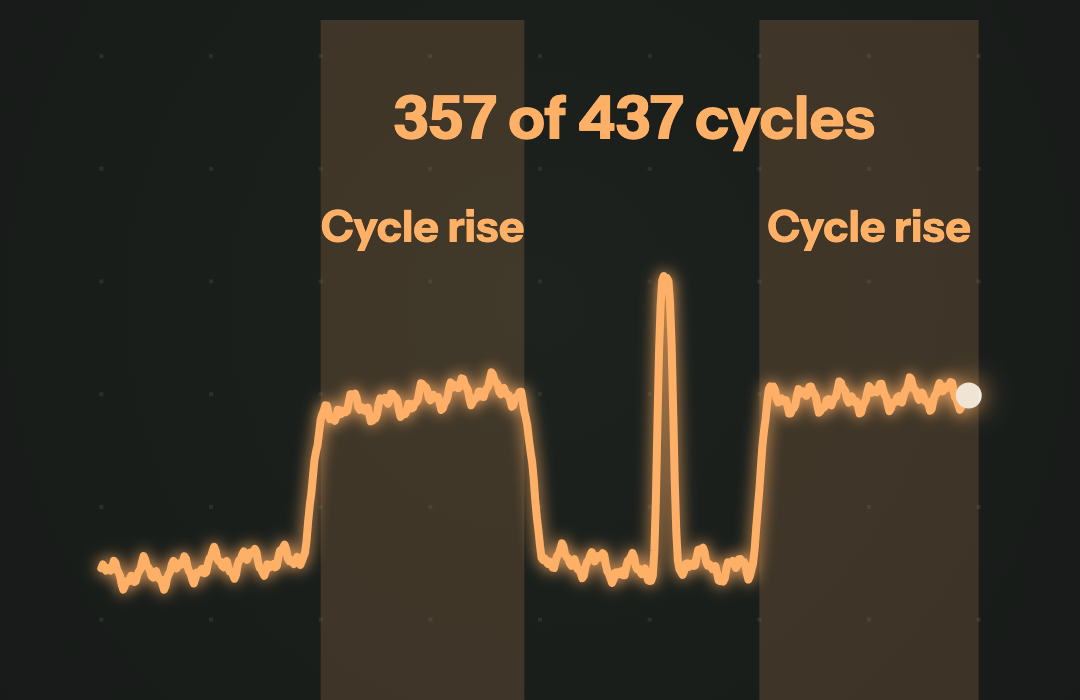
Shilaih and colleagues (2018, Bioscience Reports) followed 136 women with regular cycles who wore a wrist sensor at night and confirmed ovulation with urine LH tests. Across 437 cycles, the wrist temperature showed a sustained rise after ovulation in 357 of them, 82%.
The sensor was a bracelet from another brand (Ava), not an Apple Watch, and several authors worked for that company. The study did not compare the wrist with an oral thermometer, so it shows that the wrist can see the cycle's shift, not that it replaces basal body temperature.
For any watch: find your warm nights
Paste this into Claude or ChatGPT with your watch data. Asking for your usual range first matters: some exports give the nightly reading and some give the change, and the AI has to compare each night with your own normal either way.
Look at my nightly wrist temperature for the last 8 weeks. Work out my usual range, then list the nights I ran more than 0.5 °C above it, with my resting heart rate and sleep for those same nights. Point out any pattern (weekends, late workouts, a cycle) and remind me this is a change from my baseline, not a body temperature.Compare each night with your usual wrist temperature
With telo Pro, ask for the wrist temperatures your watch recorded over the last eight weeks. Your assistant can calculate your median in degrees and show the nights furthest from it alongside the resting heart rate and HRV recorded on those days.
Using telo, look at my nightly wrist temperature for the last 8 weeks, work out my usual from the median, and find the nights more than 0.5 °C above it, next to my resting heart rate and HRV those nights.What the test showed
On one account, telo returned 24 nights with wrist temperature out of the last 57, because the watch only records on nights it is worn with sleep tracking. The readings sat between about 35.0 and 36.05 °C, with a usual of about 35.6 °C.
No night went more than 0.5 °C above that usual. The two warmest were about 0.45 °C above, with resting heart rate of 47 and 51 bpm, both inside the normal range for that account. That is a useful answer too: a quiet stretch, with nightly swings of up to half a degree that alone mean nothing.
Where the data stops
The 82% comes from one observational study, with a different wrist sensor and women with regular cycles. Apple says the feature is not a thermometer and not a medical device, and lists diet, exercise, alcohol, the room, the menstrual cycle, illness and a loose band as things that move the number.
A warm night can be a hot bedroom. Use it as a prompt to look at the rest of the night, not as a diagnosis. Wrist temperature needs Apple Watch Series 8 or newer, Ultra or SE 3. This is not medical advice; if you feel unwell, take your temperature with a thermometer and talk to a doctor.
Practical questions
Why can't I see my temperature in degrees on Apple Watch?
The Health app shows the change from your baseline, because skin temperature at the wrist varies a lot between people and with the room. What matters is how far a night drifted from your own normal.
How long until wrist temperature starts working?
About 5 nights. Apple builds your baseline after roughly 5 nights with Sleep Focus on for at least 4 hours, wearing the watch to sleep.
Is plus 0.5 °C a fever?
No. It means warmer than your usual, not a body temperature. Alcohol, a warm room or a loose band can do it. A fever is measured with a thermometer.
Sources
- Apple Support · Track your nightly wrist temperature changes with Apple Watch
- Shilaih et al., 2018 · Modern fertility awareness methods: wrist wearables capture the changes in temperature associated with the menstrual cycle · Bioscience Reports
How this guide was prepared
The Apple Watch prompt was tested on 15 November 2026 against one account, with the owner's permission, using only telo's read tools: nightly wrist temperature, resting heart rate and sleep sessions for the last 8 weeks. The study numbers come from Shilaih et al. 2018, checked in the full text, and the feature details from Apple Support, checked on 14 November 2026; the images are frames from Reel ep27 and the lines in them are illustrative. Prepared with AI assistance.