Where fat burning peaks
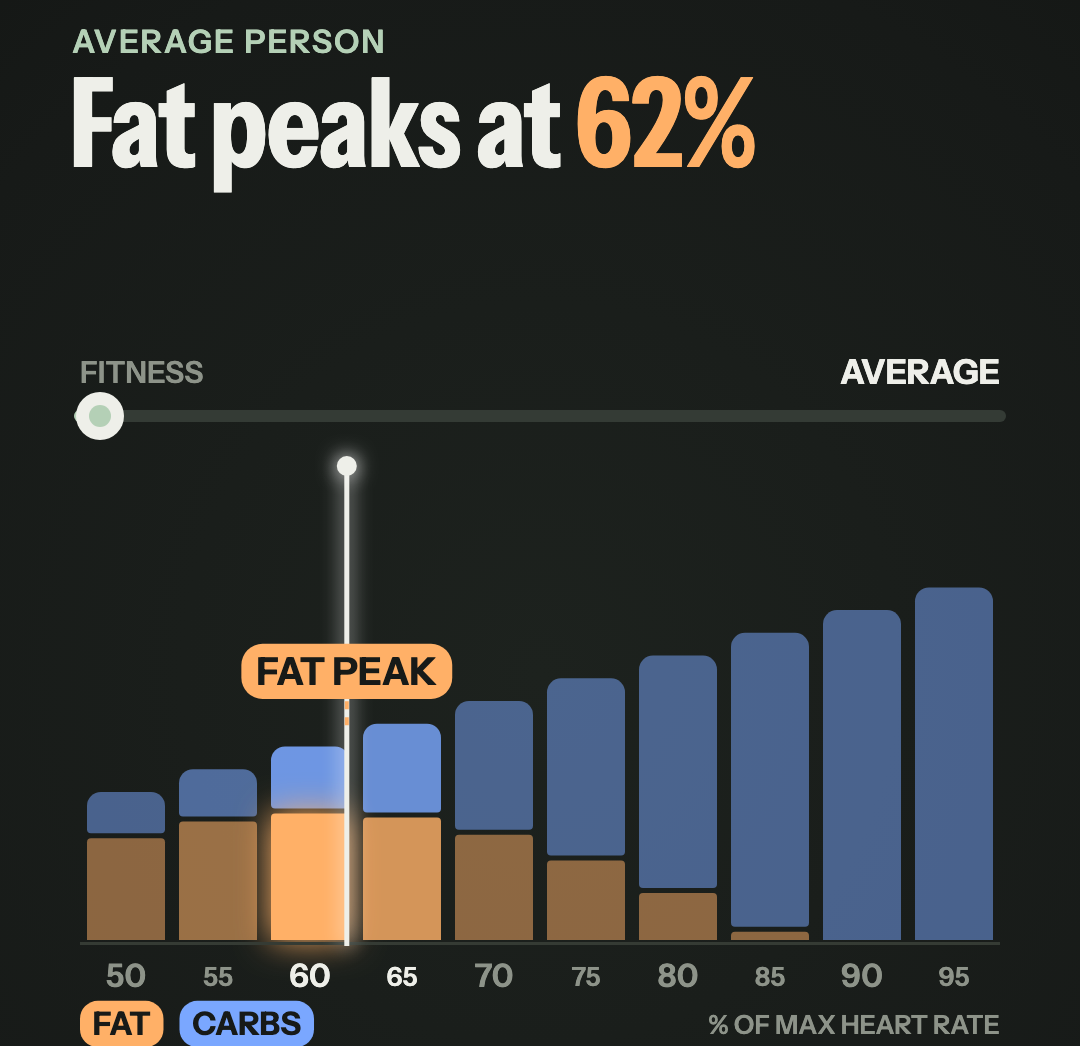
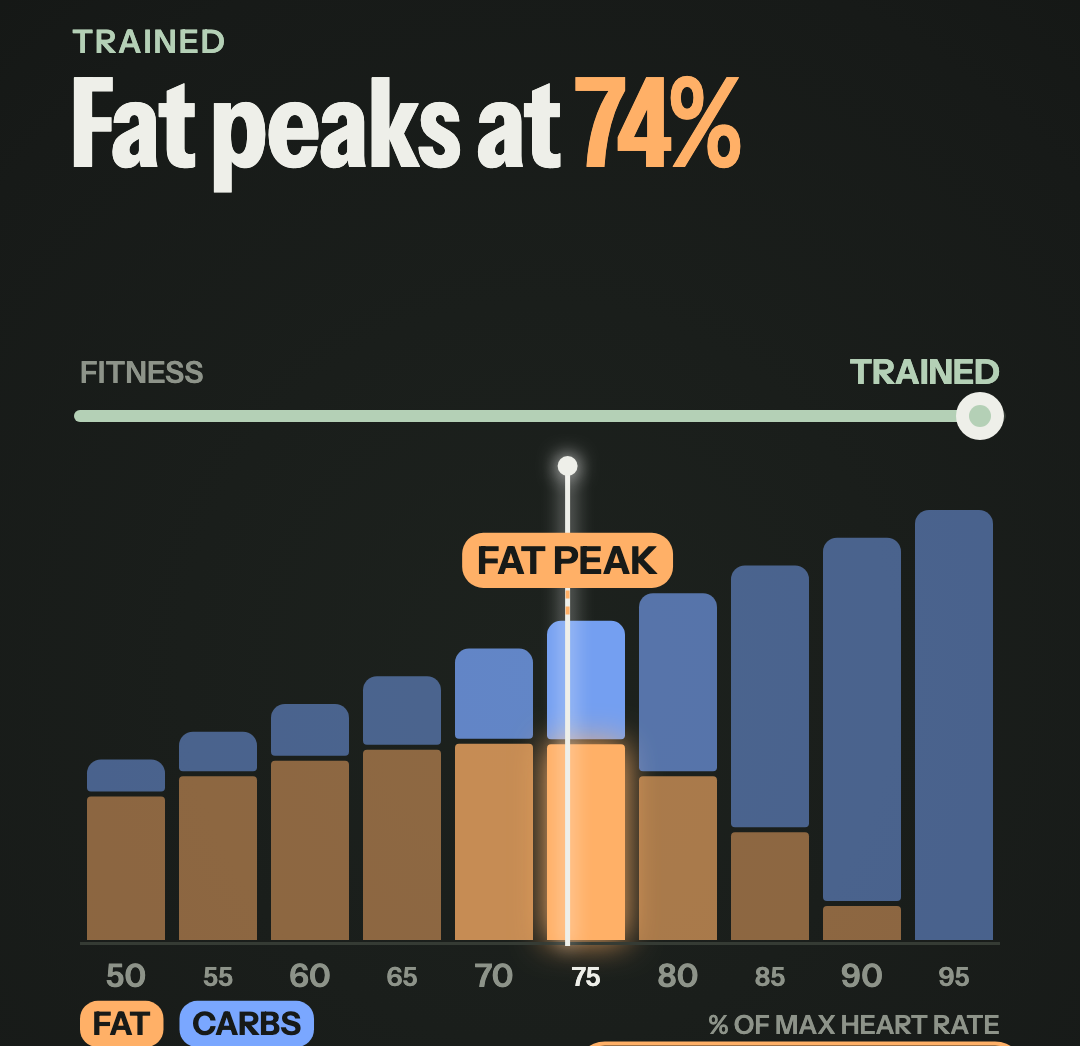
To get your range, multiply your max heart rate by 0.62 and by 0.74. With a max of 185 bpm, that is 115 to 137 bpm. The fitter you are, the closer your own peak tends to sit to the top of that range.
| Who | Fat burning peaks at | Fat at the peak |
|---|---|---|
| Average adult | About 62% of max heart rate | Lower |
| Trained | About 74% of max heart rate | About 56% more per hour in young men |
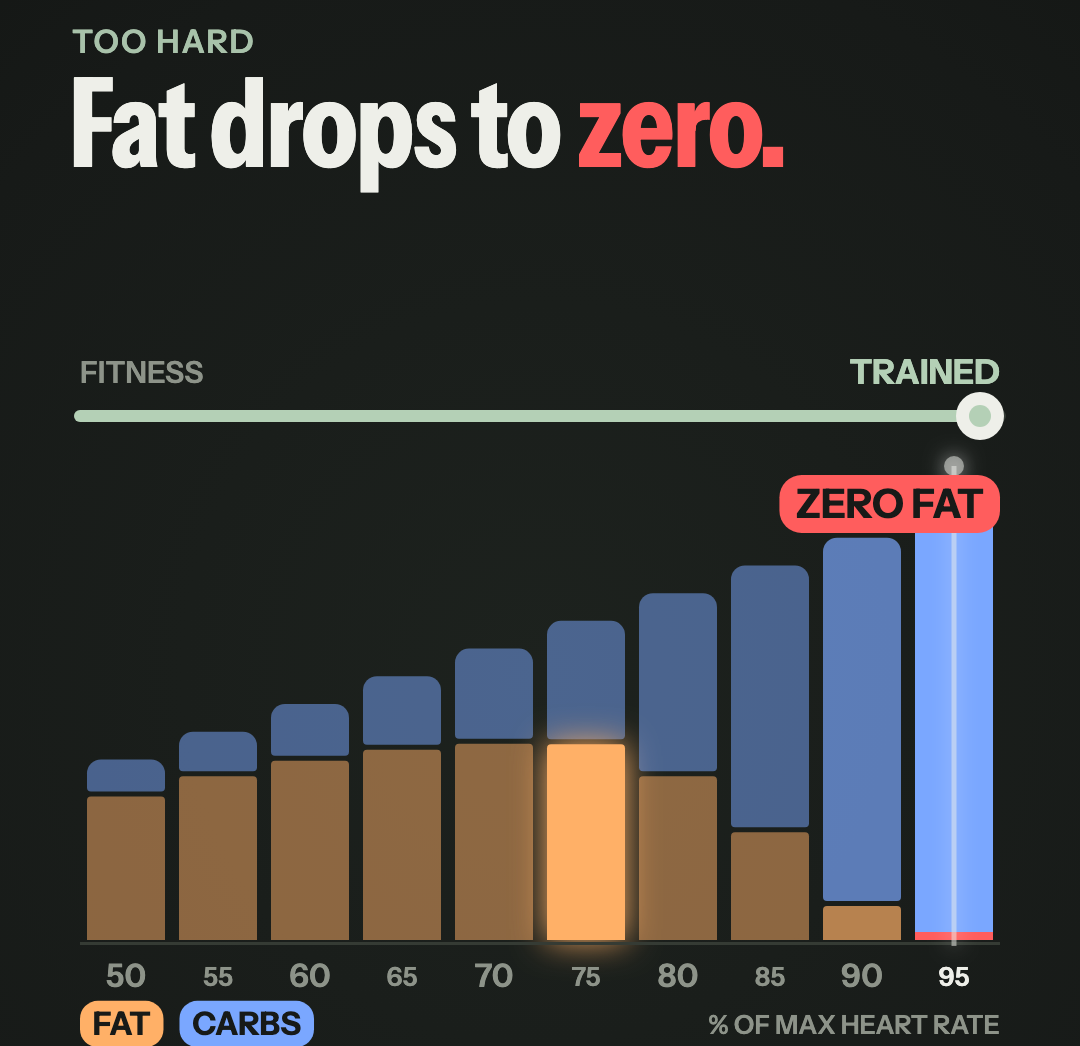
| Going too hard | Near zero above about 92% (trained) | Almost none |
What the evidence says
Venables, Achten and Jeukendrup (2005, Journal of Applied Physiology) tested 300 healthy men and women on a treadmill with the intensity rising in steps. Fat burning peaked at 48% of VO2 max on average, which was 62% of max heart rate. The spread between people was large, and body composition, fitness, sex and diet explained only about half of it.
Achten, Gleeson and Jeukendrup (2002, Medicine and Science in Sports and Exercise) did the same with 18 moderately trained male cyclists on a bike. Fat burning peaked at 64% of VO2 max, 74% of max heart rate, and the share of energy coming from fat became negligible above 89% of VO2 max, 92% of max heart rate.
Frandsen and colleagues (2021, European Journal of Sport Science) compared trained and untrained men. Young trained men burned 0.70 g of fat per minute at their peak against 0.45 g in untrained men, which is 42 against 27 g per hour. In middle-aged men the gap almost disappeared: 0.44 against 0.41 g per minute.
These studies used different people, on a treadmill in one case and a bike in the other, so putting 62% and 74% side by side is our reading and not one experiment. Burning more fat during a session also does not mean losing more body fat: total calories still decide that.
Why going harder burns less fat
As intensity rises, your muscles need energy faster than fat can supply it, and carbohydrate takes over. Total calories per minute keep going up, but the part that comes from fat falls, and close to your maximum it is almost nothing. That is why the hard session and the fat-burning session are two different days.
For any watch: find your range
Paste this into Claude or ChatGPT. If you do not know your max heart rate, use the highest number you have seen in a hard workout; the age formula can be off by 10 beats or more.
My max heart rate is [number] bpm. Give me 62% and 74% of it in bpm, tell me which end fits someone who trains [number] times a week, and write a 40-minute easy session in that range with a 5-minute warm-up and a 5-minute cool-down.Send the fat-zone session to your Apple Watch
With telo connected, your assistant reads the workouts your Apple Watch saved to Apple Health, with the highest heart rate seen and the time in each heart rate zone. It works out your range from your own number and creates the workout, which shows up in the Workout app on your watch.
On Free, the assistant sees your last 7 days of workouts, which is enough to find a recent maximum; Pro opens your whole history.
Your watch does not measure fat burning. The range is an estimate from study averages and your heart rate.
Using telo, find my max heart rate in my recent workouts, give me 62 to 74% of it in bpm, and tell me how much of my running time was in that range. Then create a 40-minute easy session in that range as a workout on my Apple Watch, with a 5-minute warm-up and a 5-minute cool-down.What the test showed
On one account, telo returned the workouts from 19 October to 19 November 2026 grouped by week, with the highest heart rate seen in them: 181 bpm. That puts 62 to 74% at 112 to 134 bpm.
For the 10 runs in that period, the answer came back with the time in each zone: about 41 minutes between 60 and 70% of that maximum and about 5 hours 23 minutes between 70 and 80%. The zones come in bands of ten points, so the answer brackets the 62 to 74% range and does not isolate it. This is one person's log and it shows that the answer comes back; it says nothing about how that person should train.
How to use your range
This is not medical advice. If you have a heart condition or take medication that changes your heart rate, talk to a professional first.
- Start at the low end if you are new to training and move up over the months.
- Use it for your easy days. Keep the hard session separate.
- If you can speak in full sentences, you are close to the right effort.
- Check the range again when your fitness changes.
Practical questions
What heart rate burns the most fat?
On average about 62% of max heart rate in healthy adults (Venables et al., 2005, 300 people) and about 74% in trained cyclists (Achten et al., 2002, 18 men). The spread between people is large, so treat 62 to 74% as a range and not a single number.
Is the fat-burning zone on a treadmill accurate?
It is a fixed range based on age, and the heart rate where fat burning peaks changes with fitness, from about 62% of max in the average adult to about 74% in trained people. It can be close for you or well off.
Does training in the fat-burning zone make you lose more fat?
Not by itself. It burns more fat during the session, but fat loss depends on total calories over days and weeks. The range is useful for easy training you can repeat often.
Can ChatGPT or Claude find my fat-burning zone from my Apple Watch?
With telo, yes. They read the workouts your Apple Watch saves to Apple Health, find the highest heart rate seen, give you 62 to 74% of it in bpm and can create the session as a workout on the watch. It is an estimate; the watch does not measure fat burning.
Sources
- Venables, Achten and Jeukendrup, 2005 · Determinants of fat oxidation during exercise in healthy men and women: a cross-sectional study · Journal of Applied Physiology
- Achten, Gleeson and Jeukendrup, 2002 · Determination of the exercise intensity that elicits maximal fat oxidation · Medicine and Science in Sports and Exercise
- Frandsen et al., 2021 · The training induced increase in whole-body peak fat oxidation rate may be attenuated with aging · European Journal of Sport Science
How this guide was prepared
The Apple Watch prompt was tested on 19 November 2026 against one account, with the owner's permission, using only telo's read tools: the workouts grouped by week from 19 October to 19 November 2026. No workout was created in the test. The abstracts of Venables 2005, Achten 2002 and Frandsen 2021 were checked on 19 November 2026. Grams per hour are the studies' grams per minute times 60. The images are frames from Reel ep38; the bar shapes between the measured points are illustrative. Prepared with AI assistance.