What 41 trials found
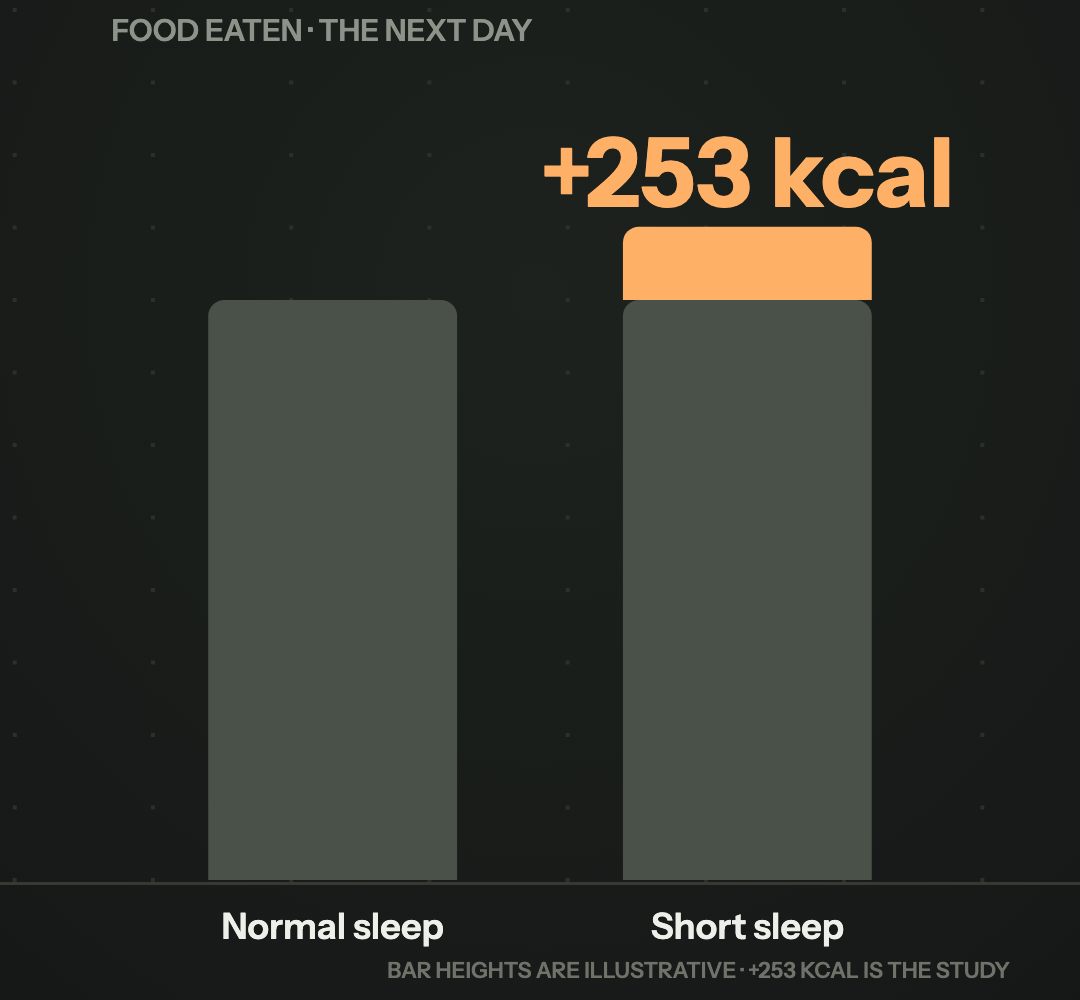
Zhu and colleagues (2019, Sleep Medicine Reviews) pooled 41 randomized trials of sleep restriction in healthy adults. With short sleep, people ate 252.8 more calories a day and rated their hunger 13.4 points higher on a 100 point scale. With partial sleep loss, weight went up 0.34 kg.
These are group averages from lab trials, where food was measured by the researchers. Your own number can be higher, lower or zero.
Why: it was the plate
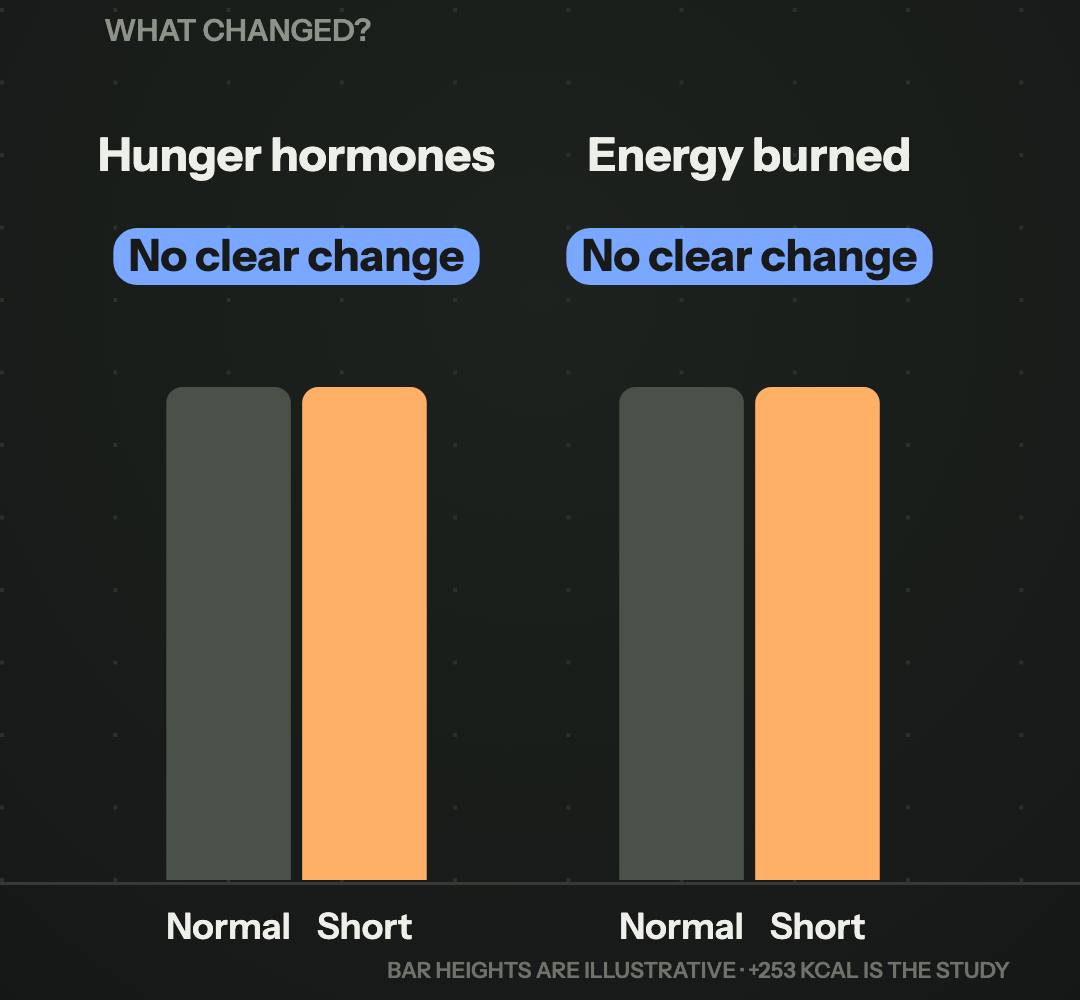
The same analysis looked for the usual explanations. Leptin and ghrelin, the hunger hormones, showed no clear change. Neither did energy burned. What changed was how much people ate.
That is useful for reading your own data: a watch sees your sleep and your movement, but not your plate. If your weight goes up in short weeks while your active energy holds, food is the likely place to look.
For any watch: line up short nights and weight
Paste this into Claude or ChatGPT with your watch data. It needs weight in the same place as sleep: a connected scale, or weigh-ins typed into your health app. Without weight, ask for sleep and active energy only.
Look at my sleep for the last 12 weeks. Split the nights into under 6 hours and 7 hours or more. For each group, show my active energy the next day, and next to it my weekly weight trend. Tell me if the weeks with more short nights line up with my weight going up, and remember you can't see what I ate.Compare your short nights with your weekly weight
With telo connected, your assistant reads each night's time asleep, the active energy of every day and your weigh-ins straight from Apple Health. Twelve weeks of history in the conversation is part of telo Pro; on Free, ask the same about the last 7 days.
Using telo, compare my nights under 6 hours with my nights of 7 hours or more over the last 12 weeks, with next-day active energy and my weekly average weight. Say how many nights are in each group.What the test showed
On one account, telo returned 33 nights across the 84 days, because the watch only records the nights it is worn. Two nights were under 6 hours, 25 were 7 hours or more and 6 fell in between.
Active energy was about 1,020 kcal on the days after the two short nights and about 1,420 kcal after the long ones. Weight was logged in all 12 weeks and the weekly average fell about 2 kg over the period, including the two weeks with a short night.
So the honest answer for this account was: two short nights are too few to say anything, and nothing here points to weight following them. Asking for the count in each group is what makes that visible.
How to read your answer
This is not a weight-loss plan and not medical advice.
- Check the counts first. A group with fewer than about 10 nights is an anecdote, not a pattern.
- Look at weeks, not days. Weight swings a kilo from water and salt alone, so compare weekly averages.
- A lower active energy after a short night can simply be a rest day. It does not show that you burned less at rest.
- The watch cannot see food. If short weeks and heavier weeks do line up, the plate is a hypothesis to test, not a result.
Practical questions
Does one bad night make you gain weight?
Not that anyone could measure on a scale. The trials found about 253 more calories eaten a day with short sleep, and 0.34 kg with partial sleep loss kept up over the trial. A single night is inside the normal daily swing of your weight.
Is it the hunger hormones?
Not clearly. Across the trials, leptin and ghrelin showed no clear change with short sleep, and neither did energy burned. People reported more hunger and ate more.
Do I need a smart scale?
No. Any weigh-in saved in Apple Health works, typed by hand or sent by a scale. A few per week is enough for a weekly average.
Sources and availability
Plans, regions and interfaces can change. Check the official sources before setting up.
How this guide was prepared
The Apple Watch prompt was tested on 15 November 2026 against one account, with the owner's permission, using only telo's read tools: sleep sessions, daily active energy and weekly average weight from 24 August to 15 November 2026. Sleep is time asleep (core, deep and REM), not time in bed, and the next day is the day the night ended. The study numbers come from Zhu et al. 2019, checked in the abstract on 15 November 2026; the images are frames from Reel ep28 and the bar heights in them are illustrative. Prepared with AI assistance.