What a week of measured sleep showed
Aili and colleagues (2017, Journal of Clinical Sleep Medicine) measured the sleep of 54 working adults with actigraphy for 7 consecutive nights. To get a reliable number, sleep percentage needed at least 2 nights and sleep efficiency at least 5. Total sleep time needed more than 7: a whole week was not enough.
That was a research actigraph on the wrist, not an Apple Watch, and the number of nights changes with the measure. The direction holds for any tracker: a single night is a weak measure of how you sleep.
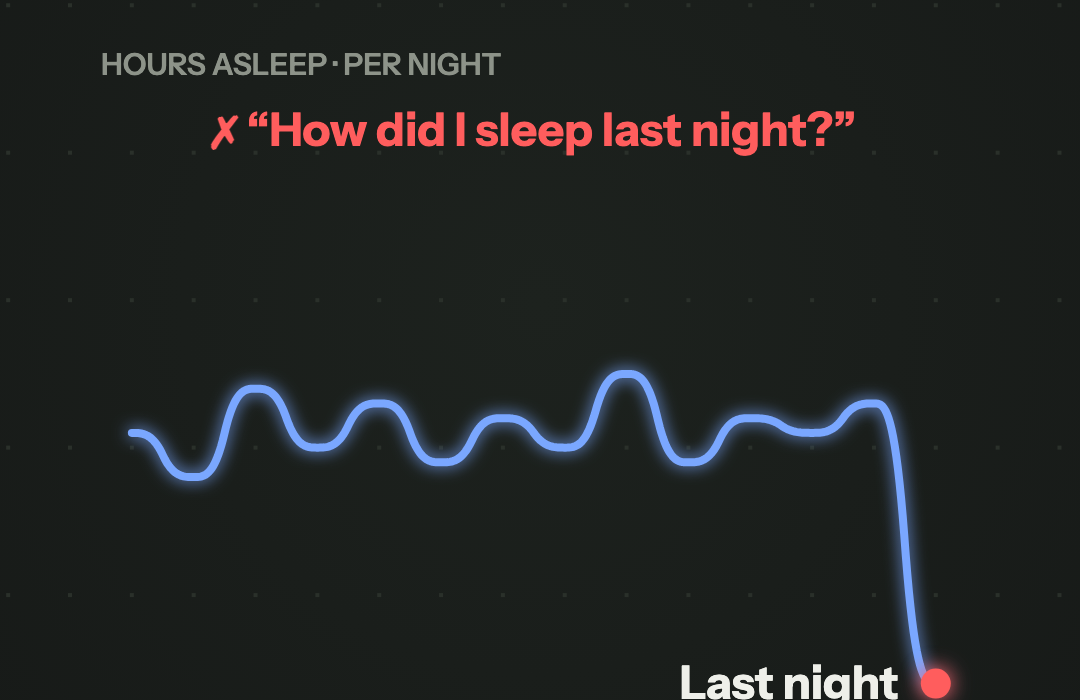
Why the AI sounds just as sure about one night
An assistant answers the question you ask. Ask about last night and it describes last night, with the same tone it would use for a month of data. It rarely says that one short night is inside your normal range.
Asking for the 5-night and 14-night averages first gives it your range, so last night becomes a point against your own normal instead of the whole story.
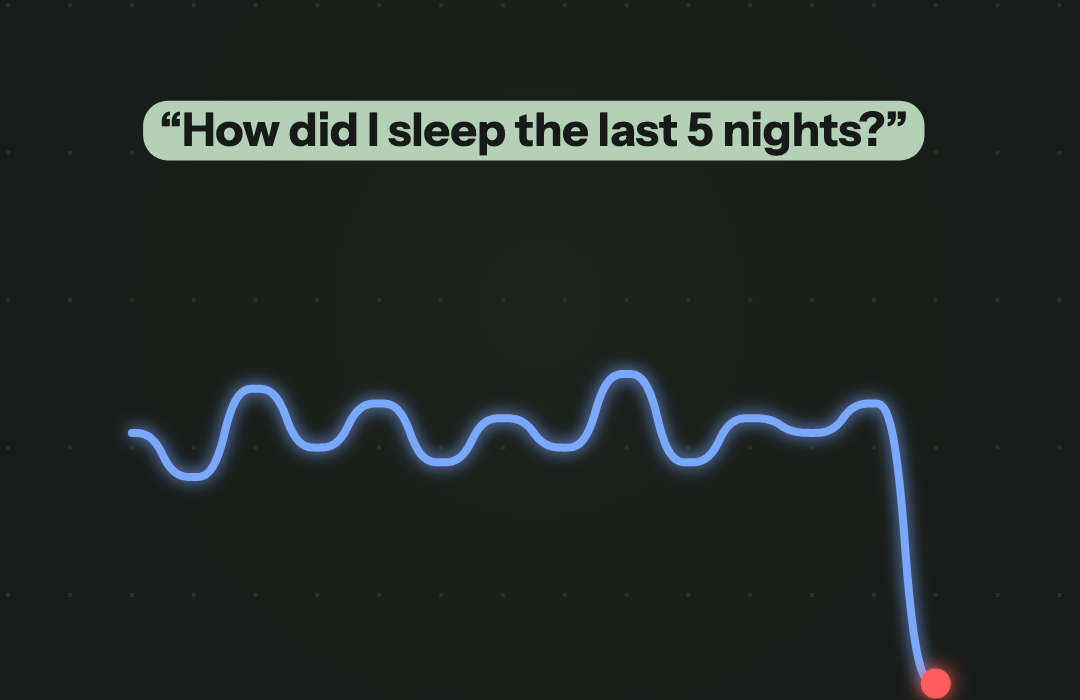
For any watch: ask about five nights first
Paste this into Claude or ChatGPT with your sleep data. The last line matters: a missing night changes an average, and you want the AI to tell you when it had fewer than 5.
Before you comment on last night, show my average sleep for the last 5 nights and the last 14 nights, with my usual range. Then tell me if last night is outside that range or just a normal bad night. Say how many nights you had data for.Check last night against your last 14 nights
With telo connected, your assistant reads every night your Apple Watch recorded from Apple Health, with time asleep, stages and time awake. Fourteen nights in the conversation is part of telo Pro; on Free, the assistant sees the last 7 days, which already covers the 5-night average.
To look at the same nights yourself, the Health tab of telo on the web opens your sleep in any browser, with your usual range. See how in the guide to Apple Health on a Mac or PC.
Using telo, list my last 14 nights of sleep, give me the 5-night and 14-night averages and my usual range, and only then tell me whether last night stands out.What the test showed
On one account, telo returned 14 nights in a row, from 4 to 17 November 2026. The 5-night average was 7.4 hours asleep and the 14-night average 7.7 hours, with nights between 5.9 and 8.9 hours.
Last night was 8.6 hours, inside the range. The night that stood out was 13 November: 5.9 hours asleep and more than 2 hours awake. Read alone, that night looks like a problem. Read against 14 nights, it was one bad night in a steady two weeks.
How to read your answer
This reads your own data. It is not a sleep diagnosis and not medical advice.
- Check the night count first. Fewer than 5 nights is not an average, it is a starting point.
- Compare last night with your range, not with an ideal number from an article.
- Look for a run, not a point. Three short nights in a row says more than one very short night.
- Check what else happened that day: a late meal, alcohol, travel or a hard workout moves one night more than a habit does.
Practical questions
How many nights of sleep data do I need?
In a study of 54 adults tracked for 7 nights, sleep percentage needed at least 2 nights and sleep efficiency at least 5 for a reliable measure; total sleep time needed more than 7. Five nights is a sensible minimum before calling anything a pattern.
Is one bad night of sleep a problem?
One night is noise. Compare it with your last 5 and 14 nights: if it falls inside your usual range, it is a normal bad night. A run of short nights is what deserves attention.
Can ChatGPT or Claude read my Apple Watch sleep?
With telo, Claude and ChatGPT read the sleep your Apple Watch saves to Apple Health, night by night, with stages and time awake. Free covers the last 7 days; telo Pro opens your whole history.
Sources
How this guide was prepared
The Apple Watch prompt was tested on 17 November 2026 against one account, with the owner's permission, using only telo's read tools: sleep nights from 17 September to 17 November 2026 and the data status. The study numbers come from Aili et al. 2017, checked in the abstract on 16 November 2026; the images are frames from Reel ep31 and the lines in them are illustrative. Prepared with AI assistance.