How far off the watch can be
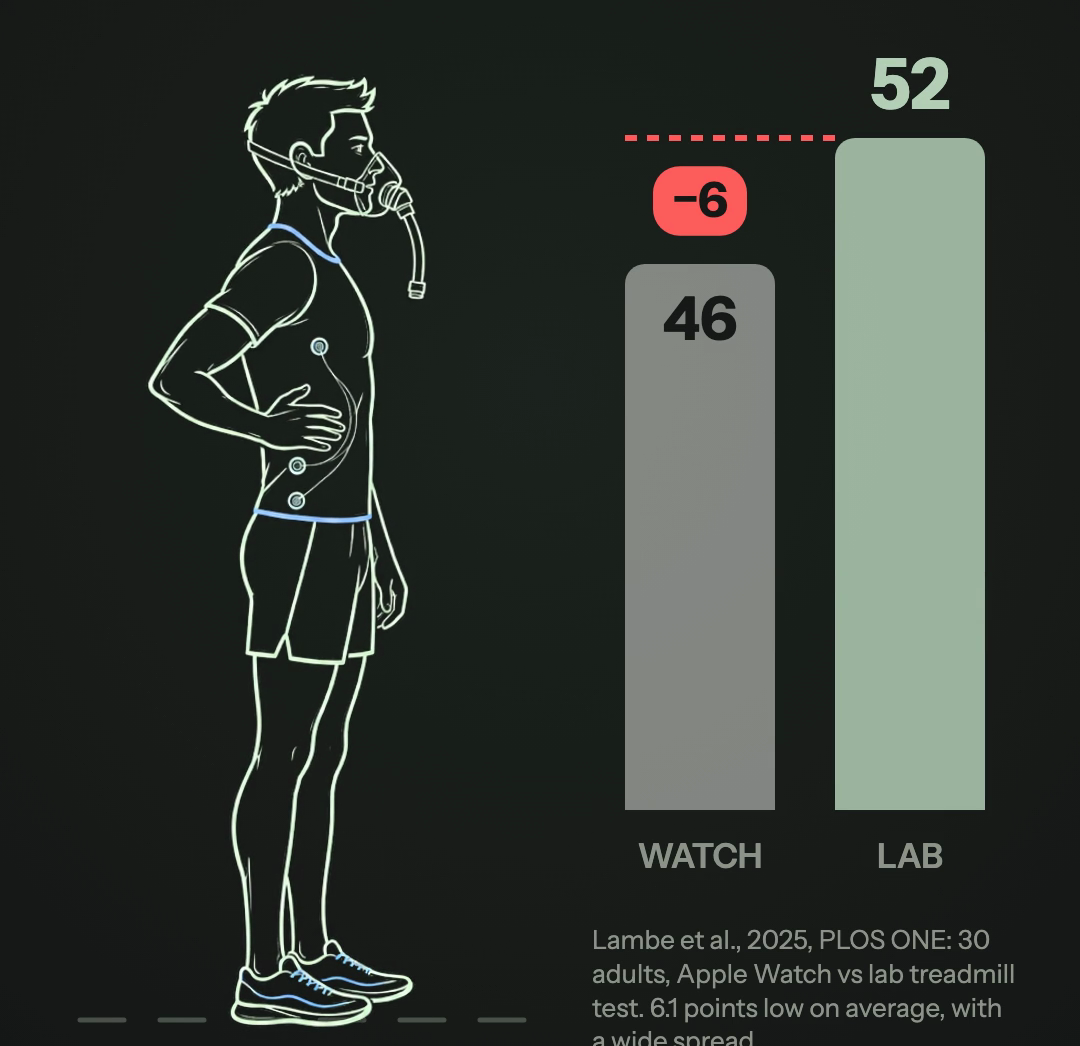
In a 2025 study, 30 adults wore an Apple Watch for 5 to 10 days and then did a maximal treadmill test with a mask in the lab. On average the watch read 6.1 mL/kg/min lower than the lab, and its typical error was about 13%. The spread was wide: for some people the watch read higher than the lab.
A 2024 study with 19 people and an Apple Watch Series 7 found a similar pattern, about 4.5 points low on average and an average error near 16%.
Both studies are small. They do not say your watch is wrong; they say a single number from it can be several points off, so it is worth checking.
How to run the Cooper test
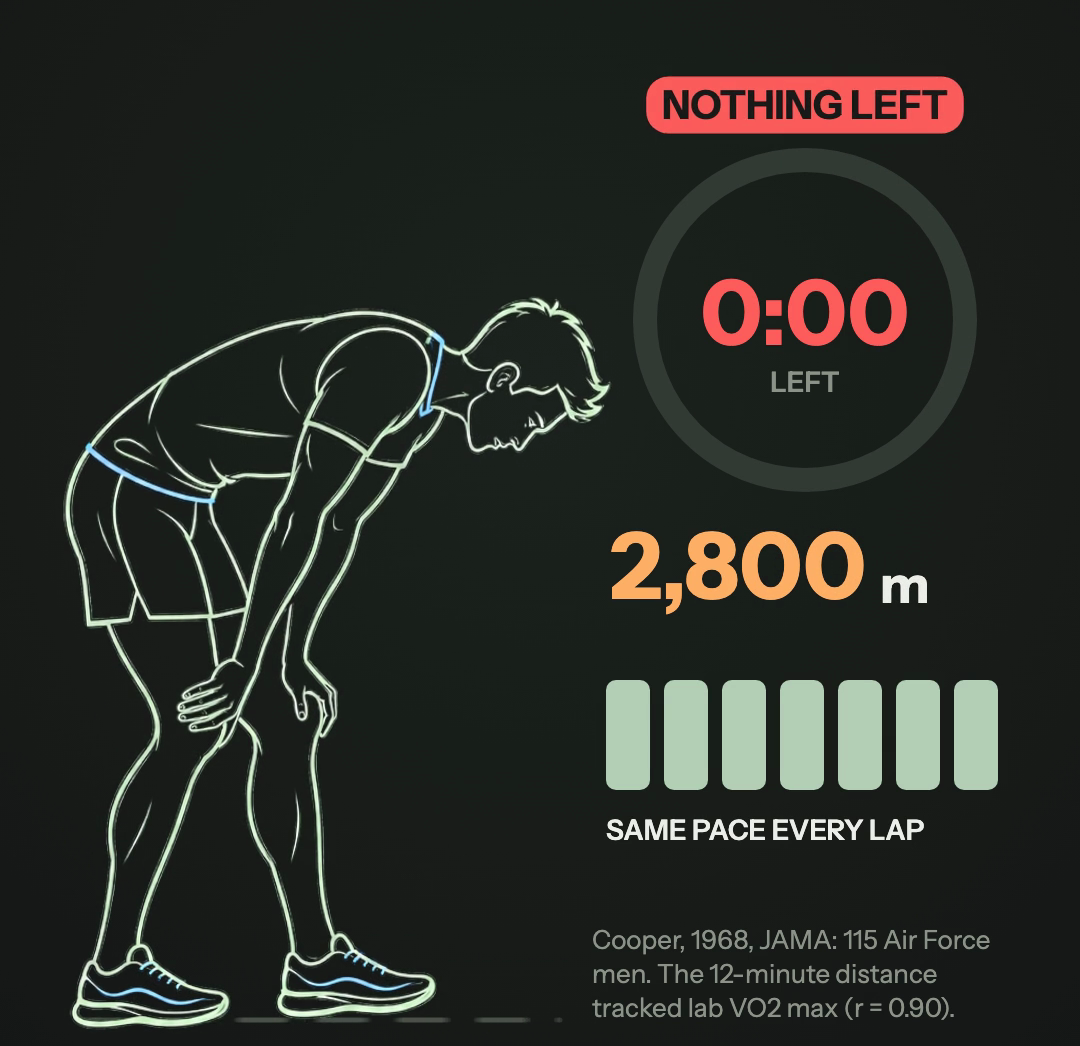
Kenneth Cooper built the test in 1968 for the US Air Force. In 115 men, the distance covered in 12 minutes tracked the VO2 max measured on a treadmill closely (a correlation of 0.90).
It is a maximal effort. If you have a heart condition, have not run in a while or feel unwell, check with a doctor first.
- Find a 400 m track or a flat route you can measure. Your watch's distance on a track can drift; count laps if you can.
- Warm up with 10 minutes of easy jogging.
- Start a timer and run as far as you can in 12 minutes.
- Pace it evenly. The goal is to have nothing left at the end, not to sprint the first lap.
- Write down the distance in metres.
The formula and what your distance means
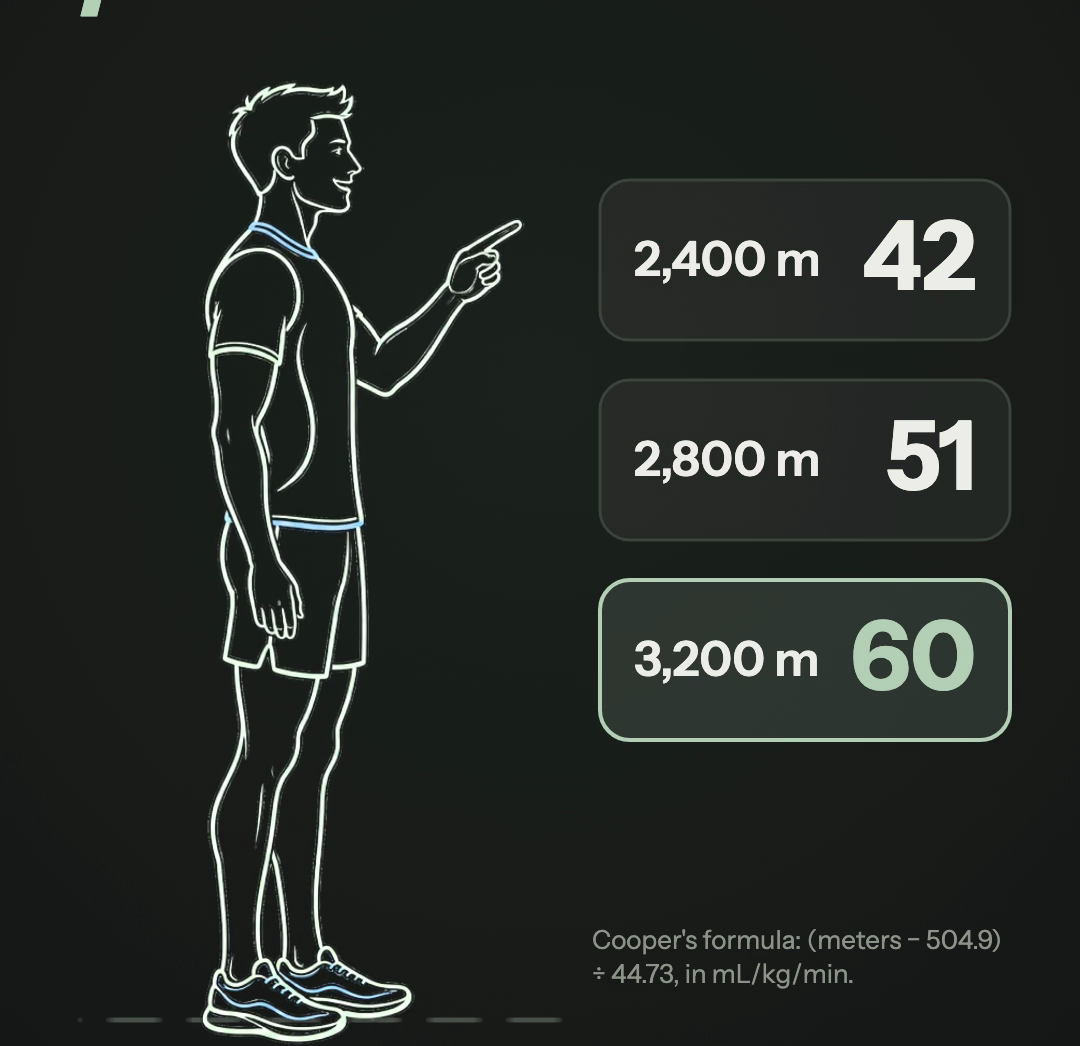
VO2 max (mL/kg/min) = (distance in metres − 504.9) ÷ 44.73. Rounded: take your metres, subtract 505 and divide by 45. In miles: VO2 max = (35.98 × miles) − 11.29.
| Distance in 12 minutes | Estimated VO2 max |
|---|---|
| 2,000 m (1.24 mi) | 33 |
| 2,400 m (1.49 mi) | 42 |
| 2,800 m (1.74 mi) | 51 |
| 3,200 m (1.99 mi) | 60 |
| 3,600 m (2.24 mi) | 69 |
Which number to trust
Neither is a lab measurement. The Cooper test was built on young men, depends on how well you pace, and a hot or windy day costs you distance. The watch estimate depends on outdoor runs with steady heart rate and GPS.
What the test gives you is a second number taken a completely different way. If the two land close, trust the watch's trend. If the test comes out several points higher, your watch is probably reading you low, and the line it draws over months is more useful than any single reading. Repeat the test every 8 to 12 weeks under the same conditions to see real change.
For any watch: turn your result into a plan
Paste this into Claude or ChatGPT with your two numbers.
I ran a 12-minute Cooper test and covered [metres] m. My watch says my VO2 max is [number]. Compute my Cooper estimate with (metres − 504.9) / 44.73, tell me how far apart the two numbers are and what could explain the gap, and suggest when and how to repeat the test so the next result is comparable.With Apple Watch: your result next to your watch's number
With telo connected, your assistant reads the VO2 max readings your Apple Watch saved to Apple Health, day by day, and the runs you recorded, with their distance.
On Free, the assistant sees your last 7 days, plus the last VO2 max reading taken before that window; Pro opens your whole history, which is what the 6-month trend needs.
Using telo: I ran a 12-minute Cooper test on [date] and covered [metres] m (if I recorded it, find the run on that date and use its distance). Compute my Cooper estimate with (metres − 504.9) / 44.73. Then pull my Apple Watch VO2 max readings from the two weeks around that date and the monthly average for the last 6 months. Show the gap, whether my watch reads low or high, and whether its trend is going up, down or flat.What the test showed
On one account, telo returned the Apple Watch VO2 max as daily readings for the two weeks before 21 November 2026, with a few days missing, and as monthly averages from May to November 2026. That is enough to place a Cooper result next to the watch's number for the same week and to read the trend. The test distance has to come from you, or from a run recorded on the day.
Practical questions
Is the Apple Watch VO2 max accurate?
On average it reads low. In a 2025 lab study with 30 adults it came in 6.1 mL/kg/min under the lab test, with an average error of about 13%, and for some people it read higher. Use the trend more than a single reading.
How do I calculate VO2 max from the Cooper test?
Subtract 504.9 from the distance you ran in 12 minutes, in metres, and divide by 44.73. 2,400 m gives about 42, 2,800 m about 51 and 3,200 m about 60.
How accurate is the Cooper test?
In Cooper's 1968 study of 115 US Air Force men, the 12-minute distance correlated 0.90 with VO2 max measured on a treadmill. It is less tested in women and older adults, and pacing and weather move the result.
How often should I do the Cooper test?
Every 8 to 12 weeks is enough to see change. Use the same route, a similar time of day and similar weather so results are comparable.
Can ChatGPT or Claude compare my Cooper test with my Apple Watch VO2 max?
Yes, with telo. It reads your VO2 max readings and runs from Apple Health, computes the Cooper estimate from your distance and shows the gap with your watch's number for the same week and its trend over the months.
Sources
- Lambe et al., 2025 · Investigating the accuracy of Apple Watch VO2 max measurements: A validation study · PLOS ONE
- Caserman et al., 2024 · Assessing the accuracy of smartwatch-based estimation of maximum oxygen uptake using the Apple Watch Series 7 · JMIR Biomedical Engineering
- Cooper, 1968 · A means of assessing maximal oxygen intake: correlation between field and treadmill testing · JAMA
How this guide was prepared
The numbers come from the three studies listed, read on 21 November 2026; the table is computed with Cooper's formula. The Apple Watch prompt was tested on 21 November 2026 against one account, with the owner's permission, using only telo's read tools: daily VO2 max for two weeks and monthly averages for seven months. The images are frames from Reel ep40; the watch and lab numbers in them are illustrative. Prepared with AI assistance.