What a side stitch is
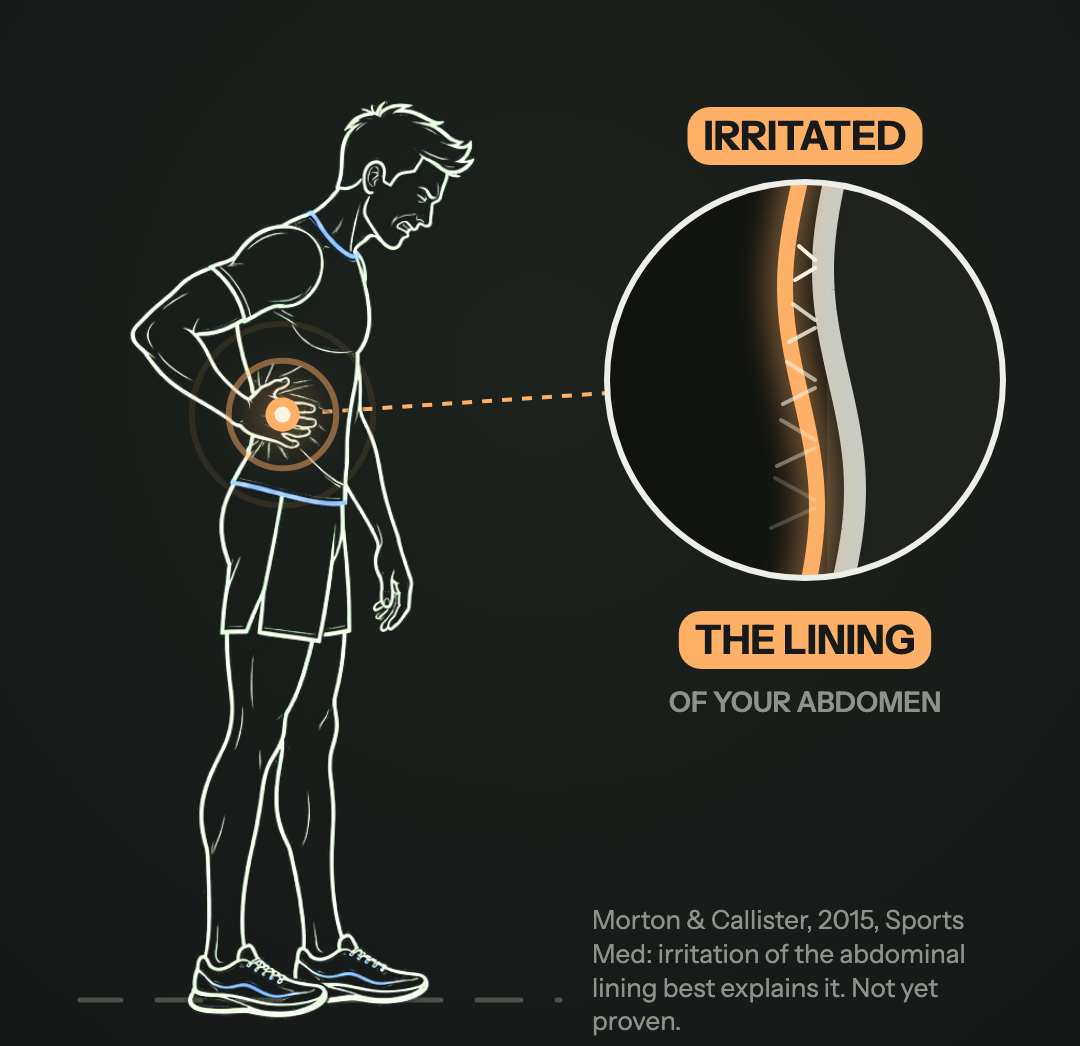
Researchers call it exercise-related transient abdominal pain. It is usually felt at the side of the mid abdomen, along the lower edge of the ribs, and the right side is reported up to twice as often as the left. Some people also feel it at the tip of the shoulder.
In a survey of 965 active people across six sports, 69% of the 439 runners had felt it in the past year. At a single event the share is lower, about one in five. It gets less common with age: 77% of active people under 20 reported it, against 40% of those over 40.
Training does not prevent it. Fitter people were as likely to have had a stitch in the past year and felt it just as strongly. They only got it less often.
Why it is not a cramp or your breathing
Two small studies measured people while they had a stitch. In 28 people, half of them with the pain, lung function did not change during an episode. In the same group, electrical activity in the muscle at the site of the pain was not raised, which is what a cramp would show. The authors concluded it is not a muscle cramp.
The idea that the diaphragm runs short of blood does not fit either: the pain also shows up in activities with low breathing demand, such as horse riding.
The explanation the 2015 review favours is irritation of the parietal peritoneum, the membrane that lines the abdominal wall. It fits the location, the sharp quality of the pain and the shoulder-tip pain. The authors say it still needs more investigation, so treat it as the best explanation so far and not as settled.
What sets it off
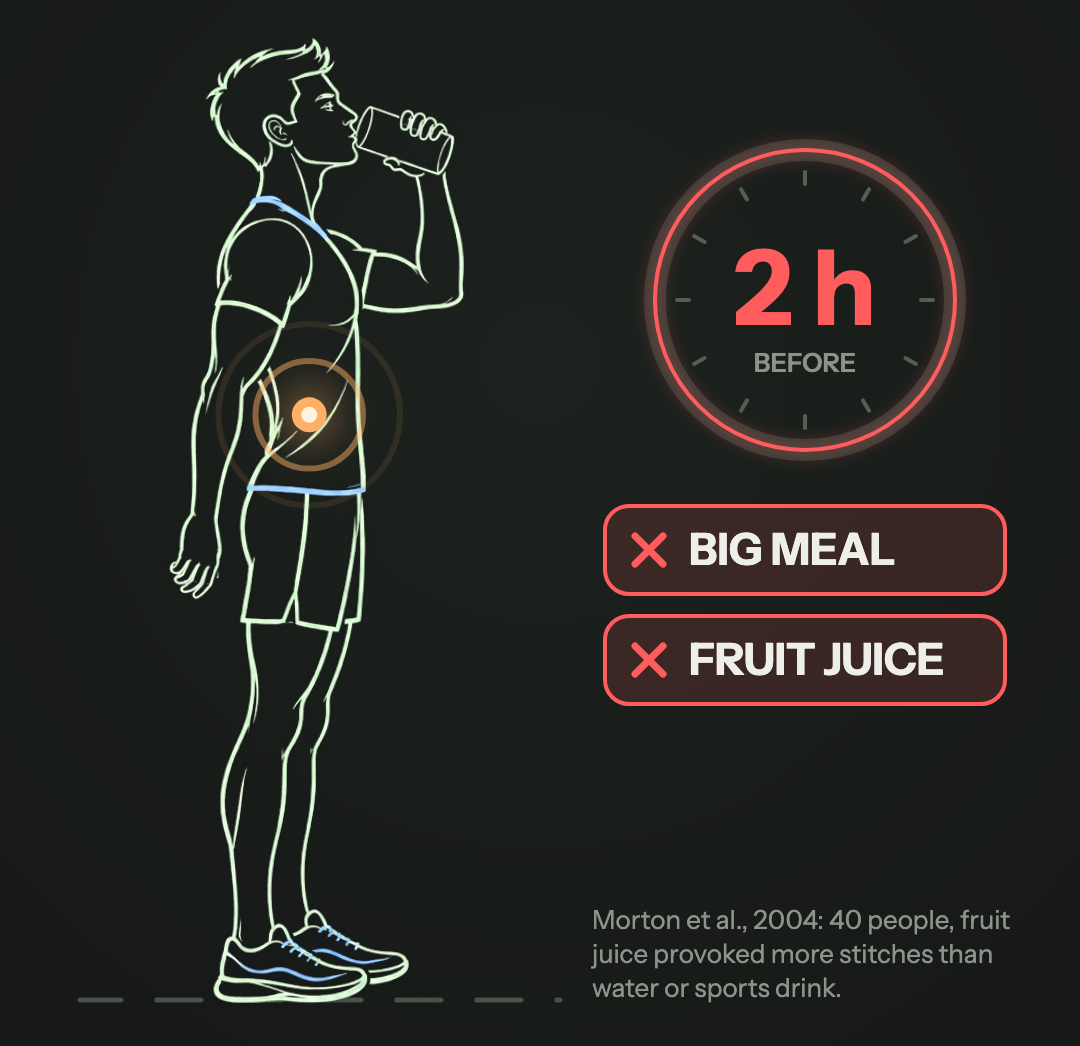
The review's advice is to avoid large volumes of food and drink for at least 2 hours before exercise, especially concentrated drinks such as fruit juice. Small sips of water or a sports drink were less of a problem.
| Trigger | What was found |
|---|---|
| A large meal 1 to 2 hours before | More likely to get a stitch during a community run (848 people) |
| Fruit juice and other concentrated drinks | More stitches than water or a sports drink (40 people) |
| Eating or drinking before exercise in general | 52% of people said eating brought it on, 38% said drinking did |
| A rounded upper back | People with more kyphosis were more susceptible (159 people) |
What to do when it hits
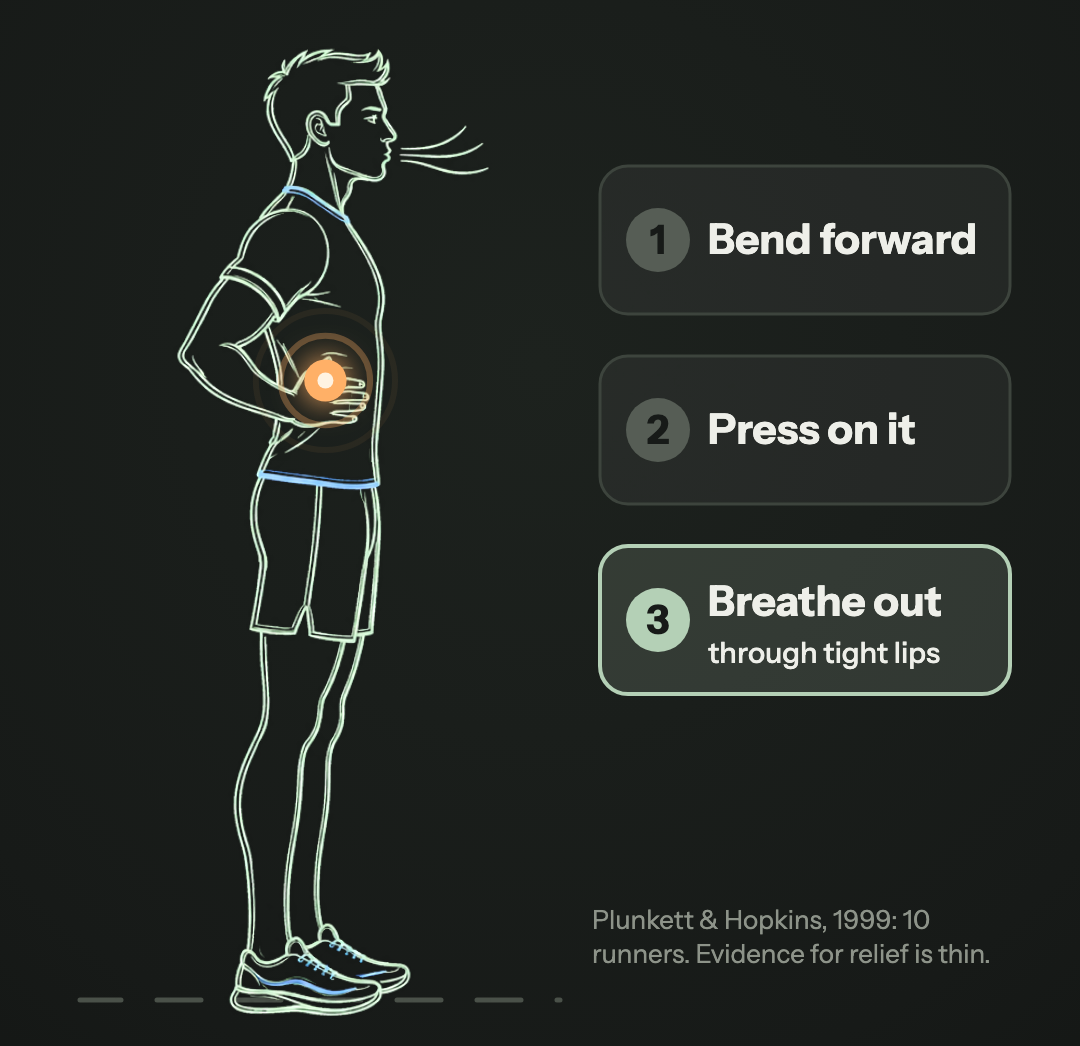
The first three come from a small study of 10 runners, where bending forward, tightening a belt around the abdomen and breathing through pursed lips eased the pain. Pressing with the hand is the same idea as the belt, and runners have reported it helps since the 1940s. The 2015 review calls the evidence for relief uncertain, so these are worth trying and not guaranteed.
A stitch goes away when you stop. Pain that stays after you rest, pain in the chest, or pain with fever or vomiting is something else and needs a doctor.
- Bend forward.
- Press on the spot with your hand.
- Breathe out slowly through tight lips.
- Slow down until it eases. Most people can keep going.
For any watch: find your likely trigger
Paste this into Claude or ChatGPT. It works from what you remember, so write down the next two or three stitches right after the run: what you ate and drank, when, and how the run started.
I get a side stitch on some runs. Ask me three things: when I last ate and drank before those runs, how fast I start compared with the rest of the run, and where exactly the pain sits. Then tell me the two changes most likely to help, based on what studies of side stitch found.With Apple Watch: what your stitch runs have in common
With telo connected, your assistant reads the runs your Apple Watch saved to Apple Health: start time, distance, the kilometre splits and the heart rate during the run. You tell it which runs hurt, and it compares them with the rest.
Your watch does not know when you had a stitch or what you ate. The comparison can only use what the watch recorded, so it can point to a pattern, such as a fast first kilometre or runs soon after lunch, and it cannot prove the cause.
The heart rate series for each run is kept for 30 days; splits and totals stay. On Free, the assistant sees your last 7 days of workouts; Pro opens your whole history.
Using telo: I got a side stitch on these runs: [dates]. Compare them with my other runs from the last 3 months: start time, the first kilometre against the average pace of that run, how fast my heart rate climbed in the first 5 minutes, and distance. Tell me what the stitch runs have in common and one thing to change on my next run.What the test showed
On one account, telo returned 17 runs from 1 October to 20 November 2026, each with its start time, duration, distance and average heart rate. For one of them it also returned the kilometre splits and the heart rate in 10-second steps: the first kilometre took 7:13, against an average of 6:43 per kilometre for the whole run.
That is enough to compare start time, the first kilometre against the average and the heart rate climb in the first minutes. The dates of the stitch runs have to come from you.
How to make it less likely
Starting slower is our suggestion and was not tested in these studies. This is not medical advice.
- Leave at least 2 hours between a large meal and your run.
- Skip fruit juice and soft drinks before running. Water is fine.
- Start the first kilometre slower than the rest.
- Add trunk strength work. In 50 runners, those with stronger trunk muscles had fewer stitches.
Practical questions
What causes a side stitch when running?
The leading explanation is irritation of the lining of the abdomen (the parietal peritoneum), according to a 2015 review in Sports Medicine. It is not proven. Measurements during a stitch found normal muscle activity and lung function, which rules out a cramp and a breathing problem as the main cause.
How do you get rid of a side stitch fast?
Bend forward, press on the spot and breathe out slowly through tight lips. These eased the pain in a small study of 10 runners. Slowing down also helps. The evidence is thin, so results vary.
Does being fit stop side stitches?
No. In a survey of 965 active people, fitter people were as likely to have had one in the past year. They got them less often.
Should I eat before running if I get side stitches?
Leave at least 2 hours after a large meal, and avoid fruit juice and other concentrated drinks before the run. Both were linked to more stitches in the studies.
Can ChatGPT or Claude find why I get side stitches from my Apple Watch?
They can find a pattern. With telo, they read your runs from Apple Health, and when you tell them which runs hurt they compare start time, the first kilometre and the heart rate climb with your other runs. The watch does not record the pain or your meals, so it shows what the runs have in common and not the cause.
Sources
- Morton and Callister, 2015 · Exercise-Related Transient Abdominal Pain (ETAP) · Sports Medicine
- Plunkett and Hopkins, 1999 · Investigation of the side pain stitch induced by running after fluid ingestion · Medicine and Science in Sports and Exercise
- Morton and Callister, 2002 · Factors influencing exercise-related transient abdominal pain · Medicine and Science in Sports and Exercise
How this guide was prepared
The numbers come from the 2015 review by Morton and Callister, read on 20 November 2026, and the studies it cites. The Apple Watch prompt was tested on 20 November 2026 against one account, with the owner's permission, using only telo's read tools: the list of runs from 1 October to 20 November 2026 and the detail of one run. The images are frames from Reel ep39; the drawing of the abdominal lining is illustrative. Prepared with AI assistance.