What 25 trials showed
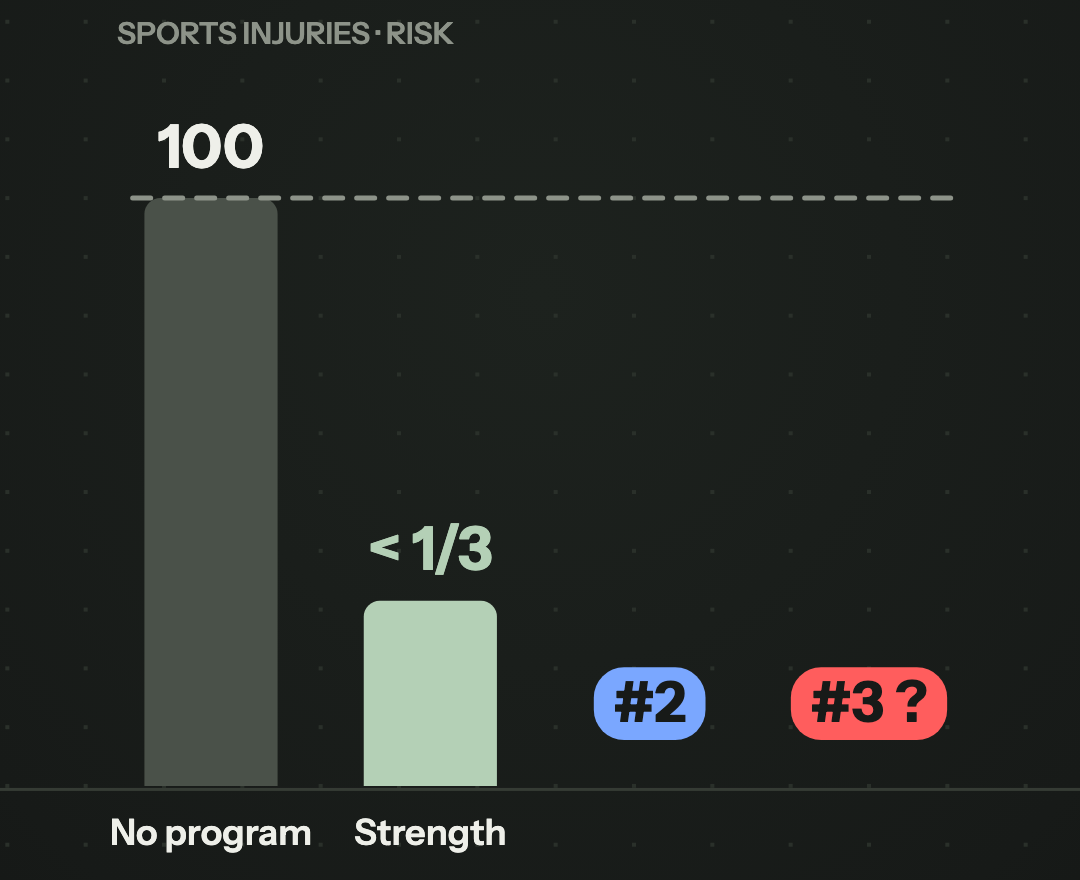
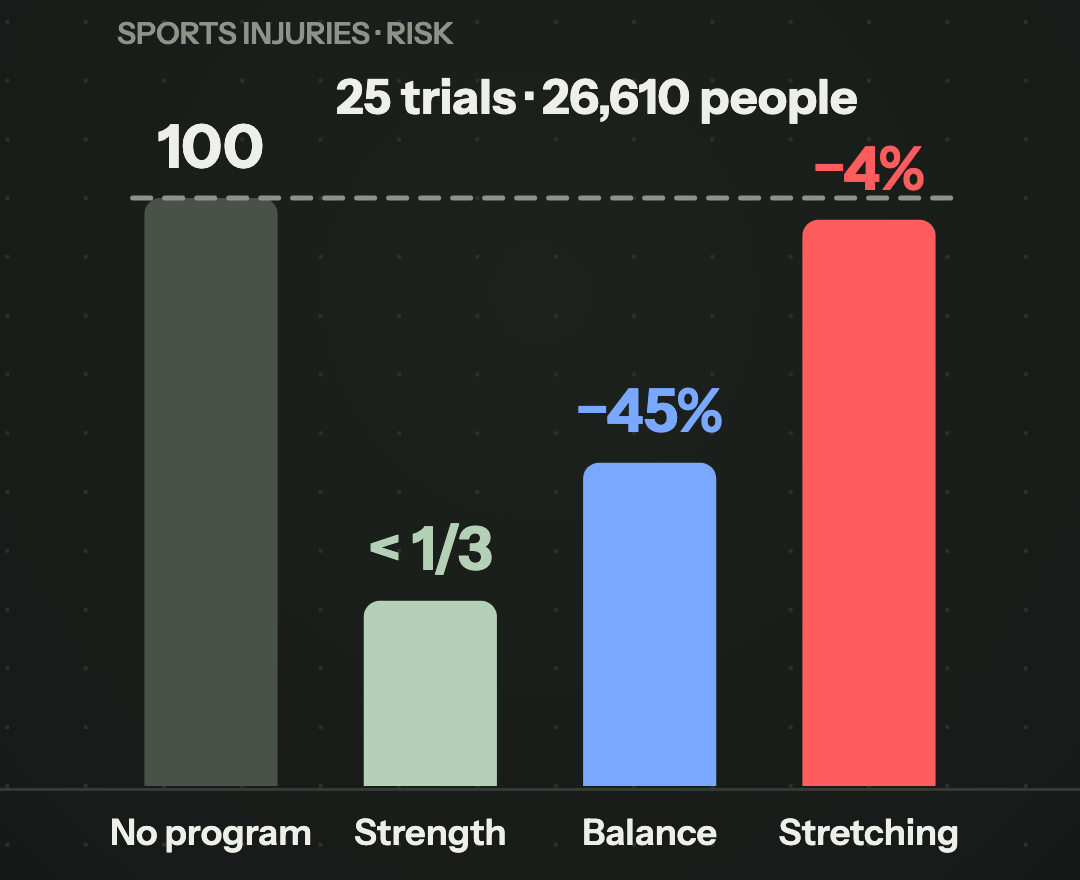
Lauersen, Bertelsen and Andersen (2014, British Journal of Sports Medicine) pooled 25 randomized trials of exercise programs meant to prevent sports injuries: 26,610 participants and 3,464 injuries. Against no program, the risk ratio was 0.315 for strength training (95% CI 0.207 to 0.480), 0.550 for balance and proprioception training (0.347 to 0.869) and 0.963 for stretching (0.846 to 1.095), which is no measurable effect.
The trials cover many sports, not only running, and only a few of them tested stretching. The strength result comes from programs that ran for weeks or months. The study did not test one session a week: that is our suggestion for where to start, not a dose from the paper.
Why stretching is not your injury plan
Stretching before a run is the most common habit in the sport, and in the pooled trials it changed injury risk by about 4%, with a range that includes zero. Balance work cut the risk by about 45% and strength work by more than two thirds.
This is about injuries. The study did not measure mobility or how a run feels, so keep stretching if you like what it does for your range of motion. Just do not count it as protection.
For any watch: count strength sessions next to your miles
Paste this into Claude or ChatGPT with your workout log from any watch or app. Most runners know their weekly distance by heart and have no idea how many strength sessions they did last month. This puts the two side by side.
Using my workouts from the last 8 weeks, count my strength training sessions per week and put them next to my running distance per week. Flag the weeks where I ran but did no strength work, and the weeks my running jumped more than 30% over the week before. Suggest where one strength session fits in my next week.Count your strength sessions from the last 8 weeks
With telo connected, your assistant reads every workout your Apple Watch saved to Apple Health, already grouped by week and by type: strength, running, cycling, swimming, walking. No export and no spreadsheet.
Eight weeks in the conversation is part of telo Pro; on Free, the assistant sees the last 7 days, which answers whether this week has a strength session yet.
To look at the same weeks yourself, the Health tab of telo on the web opens your workouts in any browser. See how in the guide to Apple Health on a Mac or PC.
Using telo, count my strength workouts per week over the last 8 weeks next to my weekly running distance, flag the weeks with zero strength sessions, and suggest where to add one next week.What the test showed
On one account, telo returned 8 full weeks of workouts, from 21 September to 15 November 2026, with strength and running as separate rows per week. It counted 20 strength sessions, 2 or 3 in every week, so no week was flagged for zero strength work.
Running went from 11.1 to 25.1 km per week. Two weeks jumped more than 30% over the week before: the week of 5 October (11.1 to 16.8 km) and the week of 2 November (14.0 to 25.1 km). Both had 2 strength sessions. This is one person's log and it shows that the answer comes back complete; it says nothing about that person's injury risk.
How to read your answer
This reads your own training log. It is not a diagnosis and not medical advice. If something hurts, see a professional.
- Look at the weeks with running and zero strength sessions first. Those are the weeks to change.
- Check that the count is right. A strength session you did not record on the watch is not in the data.
- Pick one fixed day for strength next week, away from your hardest run, and ask again in four weeks.
- Read the jump flag as a prompt to look, not a verdict. A big week after a rest week is a different thing from a big week on top of big weeks.
Practical questions
Does stretching prevent running injuries?
In a pooled analysis of 25 randomized trials with 26,610 people, stretching did not reduce sports injuries (risk ratio 0.963, 95% CI 0.846 to 1.095). The trials cover many sports and few of them tested stretching. Stretch for mobility if you like it, and use strength training for injury prevention.
How much does strength training reduce injuries?
In the same analysis, strength training reduced sports injuries to less than a third (risk ratio 0.315) and balance training cut them by about 45% (risk ratio 0.550). The study pooled different programs and did not set a weekly dose.
Can ChatGPT or Claude count my Apple Watch strength workouts?
With telo, Claude and ChatGPT read the workouts your Apple Watch saves to Apple Health, grouped by week and by type, so they can count strength sessions next to your running distance. Free covers the last 7 days; telo Pro opens your whole history.
Sources
How this guide was prepared
The Apple Watch prompt was tested on 18 November 2026 against one account, with the owner's permission, using only telo's read tools: the data status and the workouts grouped by week from 21 September to 15 November 2026. The study numbers come from the abstract of Lauersen, Bertelsen and Andersen 2014, checked on 18 November 2026; the images are frames from Reel ep34, where the bar at 100 is the baseline we set for the risk ratios. Prepared with AI assistance.