What the study found
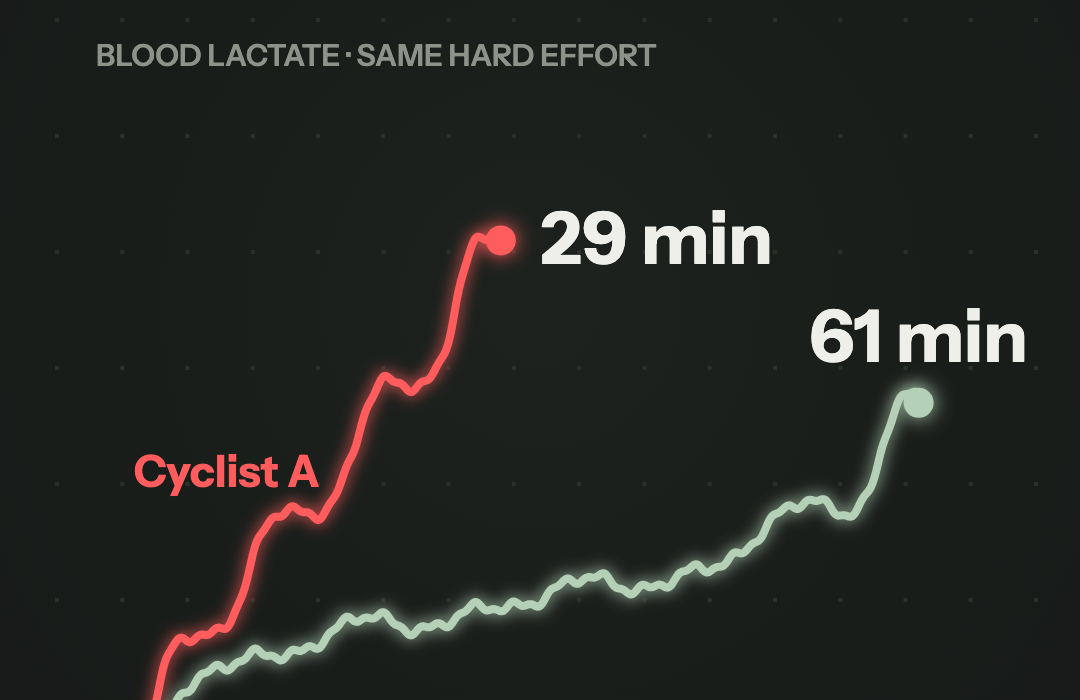
Coyle and colleagues (1988, Journal of Applied Physiology) tested 14 trained cyclists with similar VO2 max and split them by lactate threshold: one group reached it at about 66% of VO2 max, the other at about 82%. Then everyone rode at 88% of their VO2 max until exhaustion.
The low threshold group lasted 29 minutes on average. The high threshold group lasted 61. Same engine size, very different endurance. The lactate threshold is the effort above which lactate starts piling up in the blood faster than the body clears it, and the higher it sits, the longer a hard pace stays sustainable.
The talk test: a field estimate
Quinn and Coons (2011, Journal of Sports Sciences) had 15 young adults read a short passage out loud while exercise got harder, and compared that with lab thresholds. The last stage where speech was still comfortable sat close to the lactate threshold.
You can use the same idea on a run. It will not give you a lab number, but it gives you a pace and a heart rate to start from.
- Warm up for 10 minutes at an easy pace.
- Speed up a little every 3 minutes.
- At the end of each step, say one full sentence out loud.
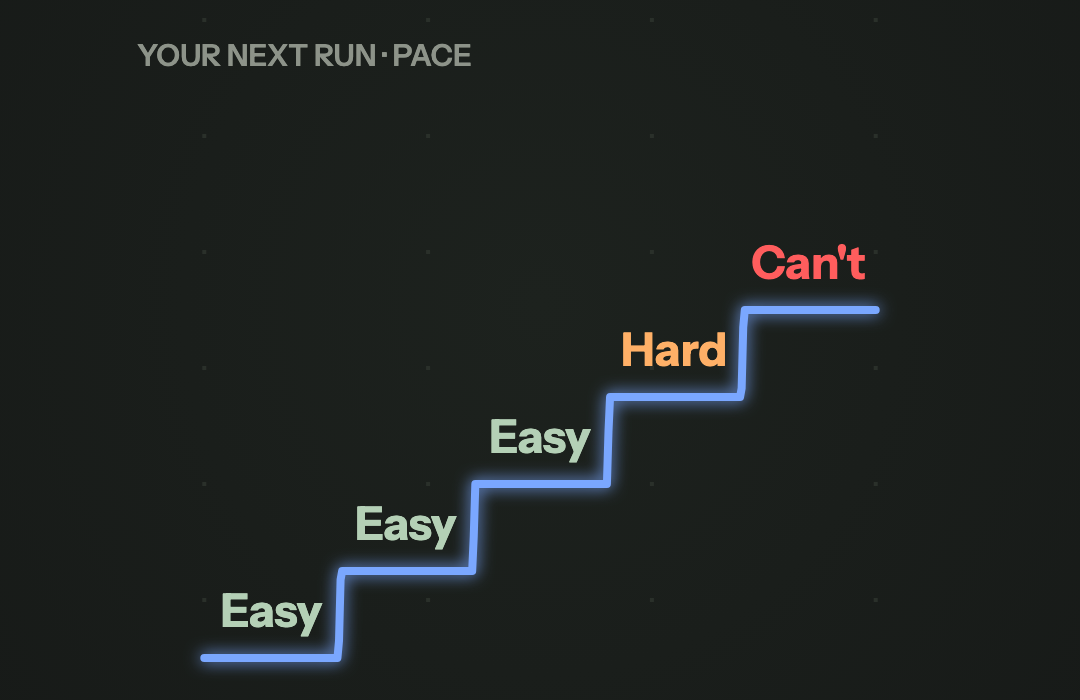
- The last pace where the sentence still comes out easy is close to your threshold. Note the pace and your heart rate there.
For any watch: find your threshold in past runs
Paste this into Claude or ChatGPT with your watch data. Asking for stretches where heart rate stays flat matters: late in a long run, heart rate drifts up at the same pace, and that drift would push the estimate too high.
Look at my runs from the last 8 weeks. Find the pace and heart rate where I spend time just above comfortable: steady runs where heart rate stays flat for 20 minutes or more without drifting up. Give me an estimated threshold heart rate and pace, tell me how confident you are with this much data, and suggest one threshold session for this week (for example 3 × 8 minutes at that heart rate with 2 minutes easy).On Apple Watch: let telo read it and build the workout
With telo connected, the AI reads every run's duration, distance and average heart rate from Apple Health, and for the last 30 days it can open the heart rate series and the kilometer splits of a run to find steady stretches. It can also put the session on your Apple Watch as a planned workout.
Using telo, look at my runs from the last 8 weeks and estimate my threshold heart rate and pace. Then create a threshold workout on my Apple Watch: 10 min easy warm-up, 3 × 8 min at that heart rate with 2 min easy, 10 min cool-down.What the test showed
On one account, telo returned 19 runs in 8 weeks, all recorded by an Apple Watch, with average heart rates from 126 to 151 bpm. Most were easy runs, so their averages say little about threshold on their own.
The useful one was an 81 minute run that got faster in the middle. Its heart rate series showed about 14 minutes steady between 160 and 167 bpm while the kilometers ran at 6:04 and 6:16 per km, after a stretch around 150 to 158 bpm at a slower pace. That puts a first estimate near 160 to 165 bpm and about 6:00 to 6:15 per km. Later in the same run heart rate stayed high while the pace slowed, which is drift, so the estimate is more likely a little high than low.
Where the data stops
The Coyle study had 14 trained male cyclists, seven per group; the talk test study had 15 young adults, and its protocol was reading a passage, not the run described here. The talk test is a field estimate, not a lab test, and it shifts with heat, fatigue and how hard you push the sentence.
Your watch stores minute by minute heart rate only for recent workouts; older runs keep a summary, so the AI can only find steady stretches in the last 30 days. Wrist heart rate can lag on fast changes. Retest every few weeks: the threshold moves with training. This is not medical advice.
Practical questions
Is lactate threshold more important than VO2 max?
For holding a hard pace, often yes. VO2 max sets the ceiling, but the threshold decides how close to that ceiling you can stay for a long time. In the Coyle study, riders with the same VO2 max lasted 29 or 61 minutes depending on their threshold.
How accurate is the talk test?
Good enough to start training with. In a study of 15 adults, the last comfortable speaking stage sat close to the lab lactate threshold, but it is an estimate. Use the heart rate you find as a starting point and adjust after a few sessions.
How do I train my threshold?
A common session is 3 or 4 repeats of 8 to 10 minutes at threshold heart rate with 2 minutes easy between them, once a week, on top of mostly easy running. Retest every 4 to 6 weeks.
Sources and availability
Plans, regions and interfaces can change. Check the official sources before setting up.
- Coyle et al., 1988 · Determinants of endurance in well-trained cyclists · J Appl Physiol
- Quinn & Coons, 2011 · The Talk Test and its relationship with the ventilatory and lactate thresholds · J Sports Sci
How this guide was prepared
The Apple Watch prompt was tested on 14 November 2026 against one account, with the owner's permission, using only telo's read tools: every run from the last 8 weeks with duration, distance and average heart rate, and the heart rate series and splits of one recent run. The workout creation step was not run in the test. The study numbers come from Coyle et al. 1988 and Quinn & Coons 2011; the images are frames from Reel ep25 and the lines in them are illustrative. Prepared with AI assistance.