1. Most of their riding is easy
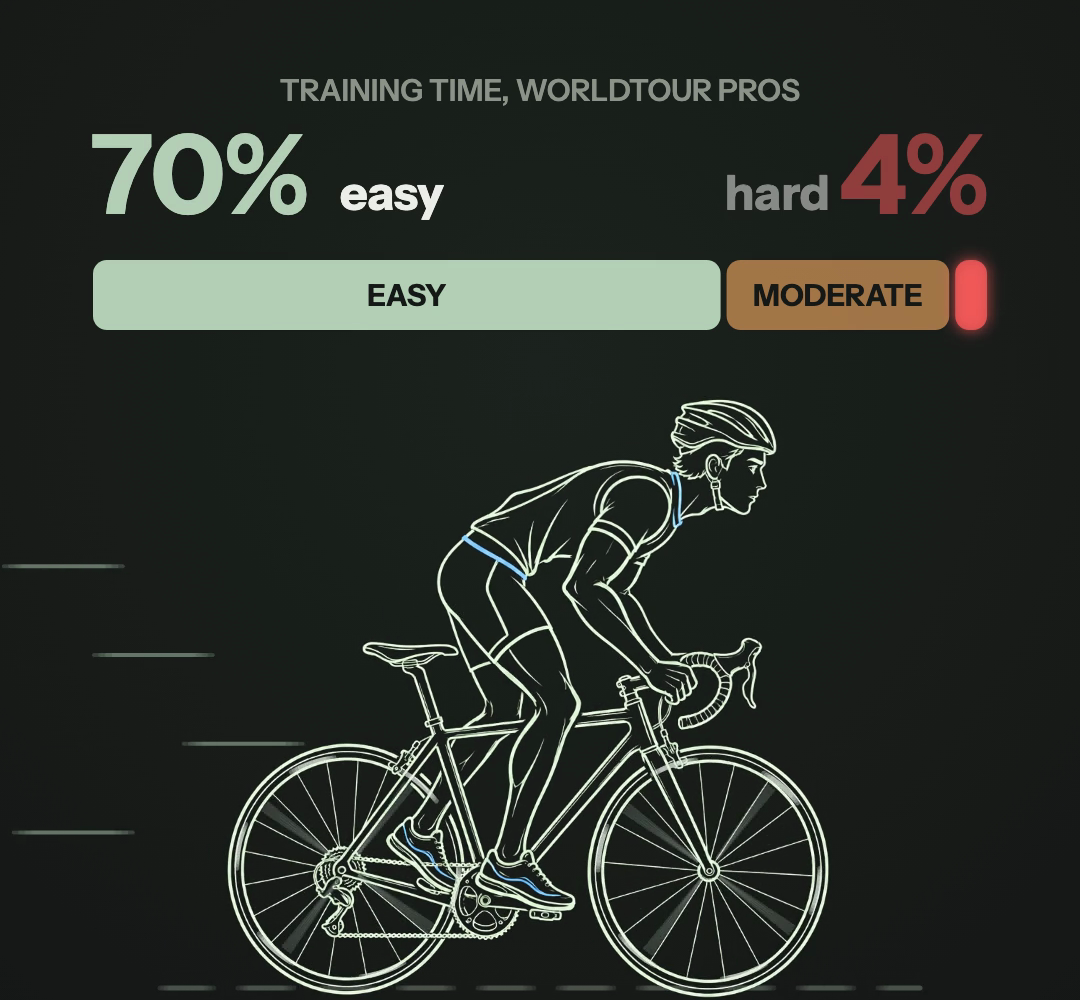
Mateo-March and colleagues analysed the 10 weeks before the first race of the season for 16 male and 16 female WorldTour riders, from power data. Men spent 70.4% of their training time at low intensity, 25.4% at moderate and 4.2% at high. Women spent 59.7% at low intensity. More than 90% of the riders followed a pyramid: lots of easy riding, less moderate, very little hard.
The men trained about 19 hours a week. You do not need their volume to copy the shape: keep most rides truly easy, so the few hard ones can be hard.
| Intensity | Men | Women |
|---|---|---|
| Low | 70.4% | 59.7% |
| Moderate | 25.4% | 32.8% |
| High | 4.2% | 7.4% |
2. When they go hard, they go short
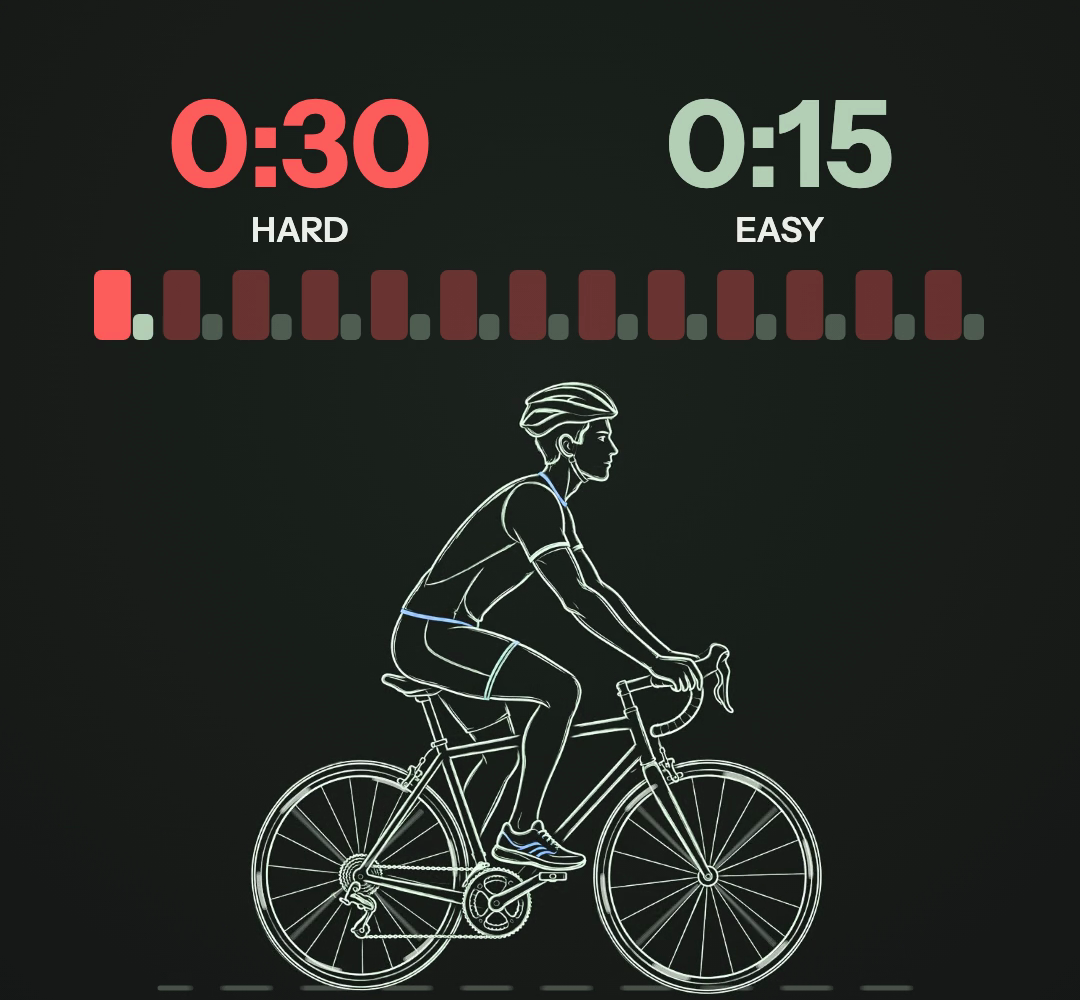
Rønnestad and colleagues compared two interval sessions in elite cyclists over 3 weeks, three sessions a week, with the same effort: 30 seconds hard and 15 seconds easy, 13 times, in 3 sets with 3 minutes between them, against 4 intervals of 5 minutes. Mean power in a 20-minute test rose 4.7% with the short intervals and fell 1.4% with the long ones.
An earlier 10-week study by the same group, twice a week in trained cyclists, found VO2 max rising 8.7% with short intervals against 2.6% with long ones.
- Warm up for 15 minutes, easy.
- Ride 30 seconds hard, then 15 seconds easy. Repeat 13 times.
- Rest 3 minutes. Do 3 sets in total.
- Cool down easy. Once or twice a week is enough.
3. They eat on the bike
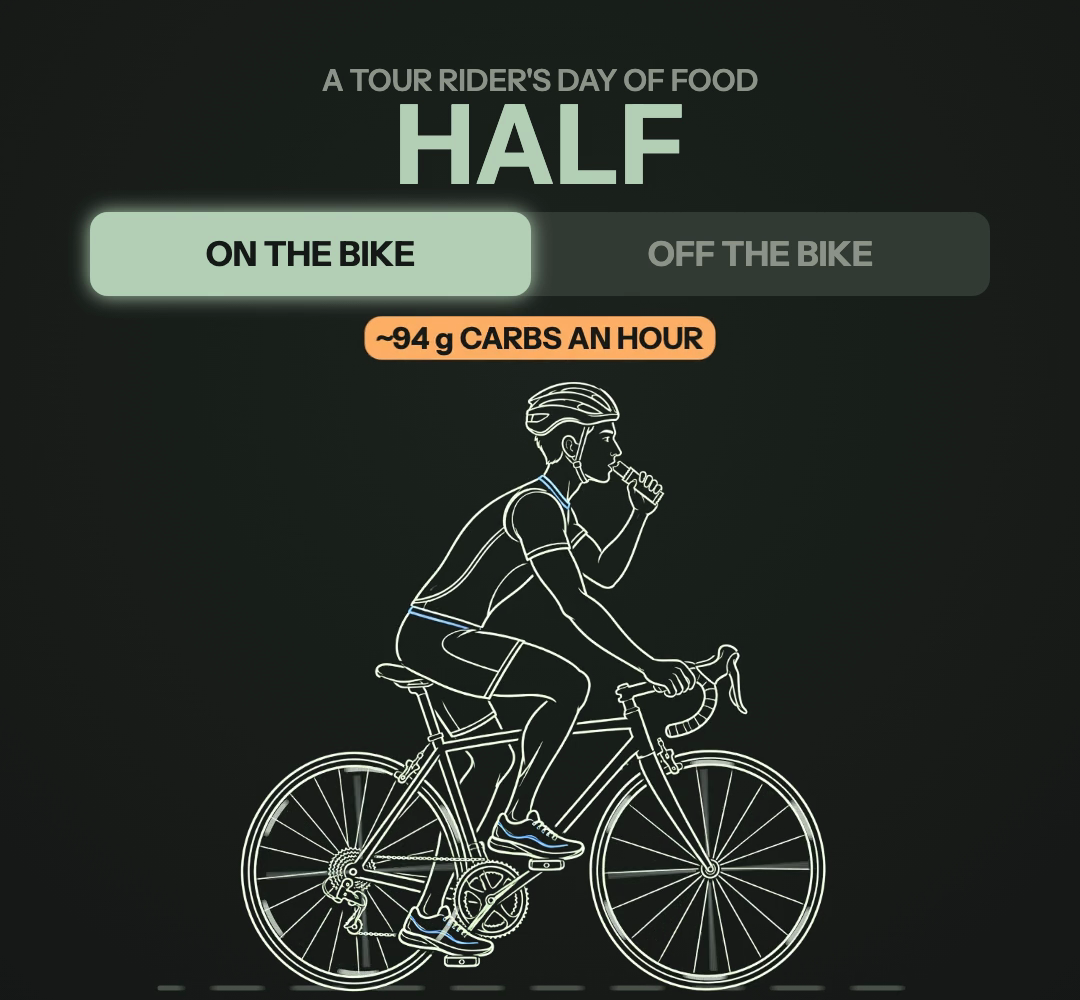
Saris and colleagues followed five riders through the whole 1988 Tour de France. 49% of what they ate each day went in during the stage, about 94 grams of carbohydrate an hour. Teams now report even more.
For an amateur, the common sports-nutrition range is 30 to 60 grams of carbohydrate an hour on rides longer than about 90 minutes, and up to 90 grams for long, hard rides once your gut is trained to it. On an easy hour, water is enough.
For any watch: how easy is your riding?
Paste this into Claude or ChatGPT with the zone times from your cycling app.
Here are my rides from the past 8 weeks with the time in each heart rate zone: [paste]. What share of my riding was easy and what share was hard? Compare it with WorldTour pros, who ride about 70% easy and 4% hard, and tell me what to change next week.With Apple Watch: your rides, zone by zone
With telo connected, your assistant reads the rides your Apple Watch saved to Apple Health, grouped by week, with duration, distance and the time in each heart rate zone.
The comparison is rough: the pros' zones come from power, and your watch's from heart rate. If you know your real maximum heart rate, add it to the prompt.
On Free, the assistant sees your last 7 days; Pro opens your whole history, which an 8-week view needs.
Using telo: pull my cycling workouts week by week for the past 8 weeks, with the time in each heart rate zone. What share of my riding was easy (under 70% of my max heart rate) and what share was hard (80% and up)? Compare it with WorldTour pros, about 70% easy and 4% hard, and tell me what to change next week.What the test showed
On one account, telo returned 8 weeks of cycling grouped by week, with duration, distance and the seconds in each heart rate zone for every week, and no rows cut. The zones were set from the highest heart rate seen in a workout, and the response says so.
Practical questions
How much do Tour de France riders train at low intensity?
In a 2026 study of 32 WorldTour riders, men spent about 70% of their training time at low intensity and about 4% at high intensity, from power data, in the 10 weeks before the season. Women spent about 60% at low intensity.
What are 30/15 intervals?
30 seconds hard and 15 seconds easy, 13 times, in 3 sets with 3 minutes of rest. In elite cyclists, 3 weeks of them raised 20-minute power by 4.7%, while 5-minute intervals at the same effort did not.
How many carbs do pro cyclists eat per hour?
In the 1988 Tour de France, riders ate about 94 grams of carbohydrate an hour during the stages, half of their daily food. Teams now report higher amounts. For amateurs, 30 to 60 grams an hour on rides longer than about 90 minutes is the usual range.
Can ChatGPT or Claude read my cycling heart rate zones from Apple Watch?
Yes, with telo. It reads your rides from Apple Health grouped by week, with the time in each heart rate zone, so the assistant can tell you how much of your riding was easy.
Sources
- Mateo-March et al., 2026 · Training characteristics of male and female World Tour professional road cyclists before the competitive phase · Biology of Sport
- Rønnestad et al., 2020 · Superior performance improvements in elite cyclists following short-interval vs effort-matched long-interval training · Scandinavian Journal of Medicine and Science in Sports
- Rønnestad et al., 2015 · Short intervals induce superior training adaptations compared with long intervals in cyclists · Scandinavian Journal of Medicine and Science in Sports
- Saris et al., 1989 · Study on food intake and energy expenditure during extreme sustained exercise: the Tour de France · International Journal of Sports Medicine
How this guide was prepared
The training split comes from the abstract of Mateo-March et al. (2026) and a summary of the paper in TOUR magazine; the intervals from the abstracts of Rønnestad et al. (2015, 2020); the Tour fueling from the abstract of Saris et al. (1989), all read on 22 November 2026. The amateur carbohydrate range is common sports-nutrition guidance, not from these studies. The Apple Watch prompt was tested on 22 November 2026 against one account, with the owner's permission, using only telo's read tools: cycling workouts grouped by week for 8 weeks. The images are frames from Reel ep42; the example card in the Reel is illustrative. Prepared with AI assistance.